How LLMs Distribute Category Vocabulary at Scale
Models amplify dominant vocabulary instead of averaging it, locking in whoever gets there first.

Most executives assume an AI model works like a blender: feed it the market's language, and it purees everything into some kind of averaged, neutral summary. That's not how it works. A large language model doesn't synthesize vocabulary. It amplifies whatever vocabulary already dominates the text it was trained on and the text it retrieves when answering a question. If a term shows up often and consistently in the sources a model treats as authoritative, that term gets reinforced every time the model generates a sentence touching that topic. If three different terms compete for the same idea, the model doesn't average them into a fourth. It picks the one with the most weight behind it and repeats that one.
This happens because of how the underlying training actually works. Instruction tuning, the stage where a model is refined to follow directions and sound helpful, adds another layer on top of this. In plain terms: the fine-tuning process that makes models more polite and more useful also makes them narrower in word choice. Alignment training, broadly, pushes models toward convergence in both the words they use and the reasoning patterns behind them. Dominant vocabulary doesn't get smoothed out. It gets amplified.
Language models process text in pieces called tokens, which are often fragments of words rather than whole words, and a deeper mechanical detail explains why planted terms don't get lost in translation at the model's internal level. Research published at ICLR 2025 found that for 85% of words tested, models reconstruct a representation of the full word's concept and write it into the token where that word ends, during the early and middle layers of processing. Models aren't just tracking statistical fragments; they're operating on whole-word concepts, built back up from pieces. A term a company plants into the public conversation doesn't get chopped up and lost. It gets reassembled and treated as a coherent unit, the same way a human reader treats "Revenue Intelligence" as one idea rather than two unrelated words sitting next to each other.
Why the vocabulary that reaches LLMs is skewed toward whoever published most and most consistently
The text that trains and feeds these models isn't a neutral cross-section of the market. The large majority of the signal comes from everyone else talking about it. The real battle for category vocabulary is fought in the publications, the analyst briefings, and the trade press that a model treats as trustworthy, not on the homepage.
Volume matters, but depth in the right place can matter more. A single authoritative source in a tightly focused, vertical-specific publication can account for a disproportionate share of everything a model says about a brand within that niche. That's the kind of asymmetry that rewards precision over noise. A company that lands one deeply credible, frequently cited placement in the publication its buyers actually read can outweigh a dozen scattered mentions in general business press.
This sets up a feedback loop that compounds over time. A term that dominates the third-party corpus gets reproduced by models in the answers they generate. It grows. This amplification mechanism, where models reinforce whatever language already dominates the training corpus, is why Storiedinc approaches narrative as infrastructure rather than messaging. If a model scales whatever vocabulary is already statistically dominant instead of inventing something new, precision in how a company plants its category terms becomes a structural competitive asset.
How instruction tuning turns vocabulary dominance into vocabulary lock-in
Instruction tuning is the process that makes a raw model behave like a helpful assistant instead of a text-completion engine that might wander off into nonsense. It's a necessary step, and it makes models far more usable. It also has a side effect that matters enormously for anyone trying to control category language: it narrows the model's vocabulary range toward whatever is already the consensus choice.
The grammar and lexicon study comparing two generations of models found that instruction-tuned versions show substantially reduced lexical diversity compared to their base, non-tuned counterparts, with the drop especially sharp in the variety of distinct word types used. If a term is dominant in training data when a model generation goes through alignment, that term doesn't just get cited frequently. It becomes the canonical reference point the model reaches for by default.
This holds even when engineers try to work around it. The convergence toward dominant vocabulary runs deeper than a setting that can be dialed up or down.
The business consequence: timing against a model's training cycle matters as much as how much a company publishes. Alignment and instruction tuning don't neutralize vocabulary dominance. Alignment and instruction tuning institutionalize vocabulary dominance, which makes narrative precision a prerequisite for responsible AI deployment. A company whose category terms are already the default when a model generation goes through alignment gets those terms locked in at a deeper level than a company that shows up in the conversation afterward, and that timing gap often decides whether a company owns a category or gets priced into somebody else's definition of it.
Accelerating LLM Adoption and Category Vocabulary Drift
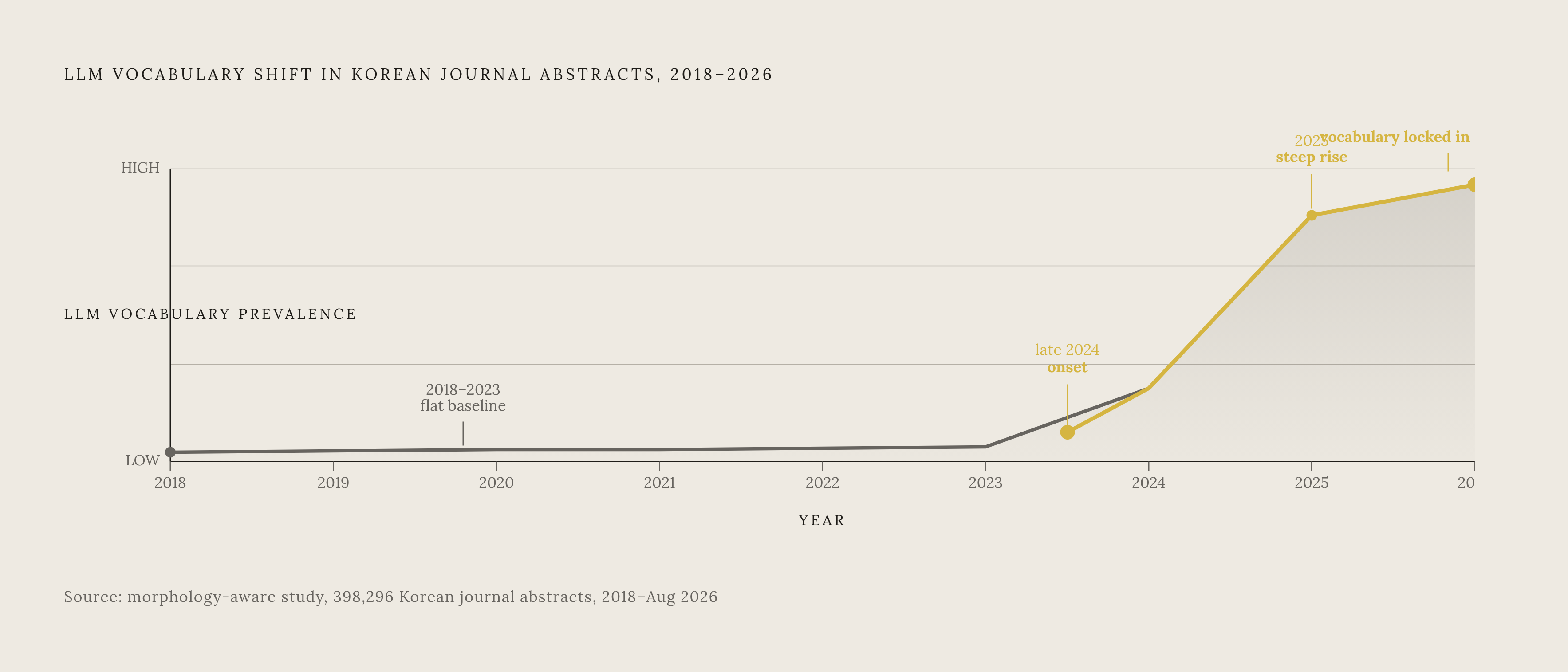
The amount of professional and academic writing produced with AI assistance is climbing fast, and that acceleration is compressing the timeline for establishing category vocabulary into something closer to a sprint than a marathon. A morphology-aware study tracking 398,296 Korean journal abstracts published between 2018 and August 2026 documents almost no shift in 2023, a clear onset of LLM-associated vocabulary change starting in late 2024, a steep rise through 2025, and a flattening out by mid-2026. That shape (flat, then a sharp climb, then a plateau) is the signature of a new vocabulary getting adopted quickly and then locking into place.
The same study found that specific terms favored by LLMs started appearing at rates far beyond anything seen in the years before 2023, crowding out the natural variety of word choice that existed previously. This pattern appears in Korean, a language structurally unlike English, indicating that the effect is a broader pattern in how LLM-assisted writing reshapes the vocabulary of entire fields once adoption passes a certain point, not a quirk of one language's relationship to English-trained models.
The implication for anyone trying to own category language is direct: the text being written right now, much of it with AI assistance, is the corpus that will train the next generation of models. Diversity loss of this kind can emerge directly from the feedback loop between models and the writing they help produce. The flattening observed by mid-2026 shows that whatever vocabulary won the acceleration phase is now settling into place as the default, not that the shift is over.
The Danger of Fragmented Organizational Language in an LLM-Amplified Environment
A company that describes itself one way on its website, another way in press releases, and a third way in its executive's conference talks hands a model conflicting signals about what it does, missing the chance to plant consistent terms. Models resolve that kind of contradiction the same way a reasonable person would: they look for the most consistent account available, and that account usually comes from third-party coverage. The company doesn't just fail to shape the narrative. It loses control of it at the exact moment it matters most.
This is a structural problem, built up from ungoverned terminology, teams in different departments using different words for the same idea, and messaging that drifts over years without anyone updating it to match, not a communications hiccup that a better slide deck fixes. The compounding sourcing asymmetry described earlier mirrors what narrative strategy firms recognize as language debt: once a term dominates third-party coverage, models reproduce it in generated text, that text feeds back into the corpus, and the term's dominance compounds further. The company that establishes its vocabulary earliest and most consistently across the channels that matter doesn't just win the narrative in front of human readers. It wins the model's internal lexicon too.
The debt metaphor holds up because debt is the right word for it. Language debt behaves like financial debt: it compounds, and the longer a company waits to address it, the more expensive the fix becomes. In an LLM-amplified environment, the interest rate on that debt climbs, because every inconsistency doesn't just sit quietly in an old blog post. It gets picked up, reproduced, and distributed at scale across every AI-generated answer that touches the topic. A competitor with clean, consistent language and solid third-party coverage doesn't need to out-innovate a fragmented rival. Coherence alone does most of the work, and the model handles distribution for free.
How companies that have defined new categories succeeded in planting vocabulary before the market had words for what they did
Companies that successfully create a new category tend to follow the same playbook, whether or not AI models were ever part of the plan. They name the space precisely, they publish about it constantly, and they do it before competitors or analysts have a chance to settle on a different label. That timing matters because once a term takes hold as the answer to "what do you call this," it's hard to dislodge.
Gong is a clean example. The effect wasn't just a prettier label. It meant that anyone (human or model) searching for a coherent answer about what Gong does would find one term, used consistently, tied directly to the company that invented it.
Unity offers a different version of the same move. By expanding the language describing who the platform served, Unity built a public record that described a market many times larger than the one a lazier label would have implied.
Both companies share the same underlying structure: they didn't wait for the market to settle on vocabulary and then try to compete inside it. They generated the vocabulary themselves, placed it into high-authority text like press releases, analyst coverage, and investor documents, and let consistency do the rest of the work over time. The same approach now runs on a faster clock and carries higher stakes. Terms planted in authoritative sources before a model generation's training cutoff become the default vocabulary in every AI-generated answer, every competitive comparison, and every market summary touching that category.
What "planting vocabulary" requires as an organizational practice
Getting category vocabulary to stick at the scale models require is an infrastructure problem, not a messaging exercise that a clever tagline can solve, and it demands the same discipline a company would apply to any system it expects to run reliably for years.
Canonical language comes first. Every term that defines a category needs one governed definition, used identically across the website, press releases, executive talks, sales materials, and investor documents. A model that encounters five slightly different descriptions of the same thing has no single signal to amplify. One that encounters the same description five times has exactly one.
Source prioritization follows directly from where models actually draw their information.
Consistency over time keeps a planted term in place and prevents a single campaign's gains from fading once attention moves elsewhere. Treat language governance as an ongoing maintenance function, not a project with an end date.
None of that works without internal alignment first. Building shared definitions and a canonical reference document that governs both internal and external language is the foundation everything else sits on.
This is what narrative infrastructure actually means in practice: a governed system of language that functions as the architectural layer underneath every communication, every AI output, and every market description a company produces, not a style guide sitting in a shared drive or a brand voice document nobody opens after the rebrand. Storied's Narrative OS is built to operate at exactly that level, treating canonical language as a compounding asset that needs maintenance, not a deliverable that gets handed off once and forgotten.
Narrative Precision as a Prerequisite for Responsible AI Deployment
Because models scale whatever narrative a company already runs on, bolting AI onto fragmented or imprecise language doesn't fix the underlying problem. It amplifies it, pushing the confusion out across every AI-generated output the organization produces and every AI-mediated answer the market encounters about it.
The same mechanism that rewards precise, consistent language punishes its absence. A model doesn't pause to correct an unclear narrative before repeating it. It reproduces and distributes whatever it finds, at a scale no internal communications team could match on its own. AI assistants have been documented to misrepresent content in a meaningful share of their responses. No company can assume a model will describe it accurately even when the underlying source material is accurate. The one lever a company actually controls is what source material exists and how consistent it is.
A review of enterprise LLM deployment published in Information Processing & Management names accuracy, integration, ethical risk, and data quality as the persistent challenges organizations run into. Narrative precision is a data quality problem sitting at the language layer, and it needs solving before the AI layer gets added on top, not after something has already gone sideways in public.
The reframe for executives is straightforward: language strategy is a precondition for responsible AI deployment, for owning a category, and for keeping an organization aligned at scale, not just for good marketing copy. Treating language as a soft, deferrable asset is the structural error that LLM amplification turns expensive. The companies that end up owning their categories in an AI-mediated market won't necessarily be the ones with the best product sitting in the demo. They'll be the ones whose language is precise enough, consistent enough, and distributed widely enough that a model, left to its own devices, has no alternative text to reach for. It just repeats theirs.
Sources
- An LLM-Associated Register Shift in Korean Journal Abstracts: A Morphology-Aware Excess-Vocabulary Study, 2018-2026
- Published as a conference paper at ICLR 2025 FROM TOKENS TO WORDS:
- More Aligned, Less Diverse? Analyzing the Grammar and Lexicon of Two Generations of LLMs
- Large language models for business and management applications: A review - ScienceDirect