How Salesforce Named and Owned CRM
Salesforce won by controlling what people called the problem, not by building better software.
What Salesforce set out to do in 1999, and how that intent was written down from day one
Salesforce didn't beat Siebel Systems by writing better code. It beat Siebel by controlling the vocabulary: what people called the problem, what they called the fix, and eventually what they called themselves. That's the whole argument here, and the stock ticker at the end proves it better than any case study could.
Marc Benioff left Oracle and started Salesforce in March 1999, working out of a rented one-bedroom apartment at 1449 Montgomery Street on San Francisco's Telegraph Hill. Founding date: March 8. Co-founders: Parker Harris, Frank Dominguez, and Dave Moellenhoff. Four people and a lease, not exactly a war room.
The founding vision statement, written before there was a product to sell, read: "A World-Class Internet Company for Sales Force Automation." That still leaned on the clunky old category label, SFA, the very term Salesforce would spend the next few years burying. Even the company that would go on to rewrite the industry's vocabulary started out borrowing someone else's.
The format mattered more than the wording. Benioff wrote the first V2MOM (Vision, Values, Methods, Obstacles, Measures) on the back of an envelope, not a slide deck, not a strategy offsite. That envelope was a narrative contract, a document everyone in the company would read from the same page, literally.
The original Values were blunt: "world class organization," "time to market," "usability." No poetry, just a startup fighting to survive. The operating mantra was "no fluff," everything done fast, simple, and right the first time. Internal language matched the external pitch from day one, which is rarer than it sounds. Most companies run two different scripts and hope nobody notices. By the end of year one, Salesforce had 40 employees, small enough that alignment was still personal, though the system was already built to outgrow that size.
The three-part language system Salesforce built to displace Siebel: a villain, a slogan, and a symbol
Every story needs an antagonist, and Salesforce picked one nobody could miss: installed enterprise software. Expensive to buy, slow to deploy, and prone to sitting on a shelf unused after companies had already paid for it. Siebel Systems was the face of that problem, which handed Salesforce something more useful than a market analysis. It handed them a villain to point at.
The slogan followed the villain the way a punchline follows a setup: "The End of Software." Not "better CRM." Not "cheaper CRM." Salesforce refused to compete on Siebel's scoreboard, features, customization depth, enterprise complexity, because on that scoreboard, Salesforce lost every time. Rather than compete on features, customization depth, or enterprise complexity, the company changed what got measured instead. That's a company rewriting the rules of comparison in its own favor.
Then came the symbol: a red circle with a line through the word "software," worn at events, printed on ads, baked into the whole visual identity. Then, because subtlety was never the point, the phone number: 1-800-NO-SOFTWARE. The brand argument lived inside the company's own contact information. Try getting that on a business card without smiling a little.
The launch itself, February 7, 2000, at San Francisco's Regency Theater, wasn't a press release. It was a concert with The B-52s and 1,500 people, built entirely around burying a product category on stage. Benioff's own explanation gets at the method directly: "I spend a lot of time creating metaphors to explain what we do." Salesforce was pitched as "Amazon.com meets Siebel Systems." Later, AppExchange became "the eBay of enterprise software." Every metaphor borrowed something familiar to make something unfamiliar click fast.
How Salesforce took its narrative into Siebel's territory, literally
In March 2000, Salesforce hired actors to stage a fake protest outside a Siebel Systems conference, signs and all. The Wall Street Journal covered it, the company's first major press hit. A fake news crew, labeled "Channel 22," filmed the protest and interviewed the paid protesters. Then actual news networks showed up to cover the fake crew covering the fake protest. That's not a marketing funnel; it's a hall of mirrors, and it worked anyway. The stunt drew widespread press coverage, pulling competitors' customers into Salesforce's orbit through articles rather than ads.
The taxi move deserves its own paragraph, honestly. At Siebel's European Users Week in Cannes, Salesforce rented every available taxi from the Nice airport. Conference attendees landed, needed a ride, and got a captive 45-minute "NO SOFTWARE" pitch whether they wanted one or not. Nobody signs up for a taxi lecture, but nobody had another car either.
Benioff summed up the payoff cleanly: the stunt built internal morale, generated great press, and pulled a competitor's own customers into Salesforce's message, all from one campaign. PR Week called it "Hi-Tech Campaign of the Year." The chaos on the surface, signs, taxis, fake news trucks, wildly different formats, comes from a discipline that produces it: the same four words every time. That repetition is what turned a string of pranks into something that felt like a movement.
Siebel held around 45% of the CRM market in 2002. Eventually, under mounting pressure from Salesforce and others, Oracle acquired Siebel. The villain got written out of its own story, which is about as clean an ending as marketing ever gets.
Distributing the language internally so the narrative didn't depend on Benioff alone
The expectation was clear: explaining what Salesforce did and stood for was not a marketing team's job. Everyone's job. To make that stick, Salesforce embedded that canonical language directly into how employees communicated day to day, doing the work modern companies pay consultants six figures to half-solve.
The V2MOM cascaded top down through functions, teams, and individuals, and every employee wrote a personal version tied back to the company-level document. That matters because most companies never close this gap. Here's the actual failure mode it prevents: a strategy gets set at the top, restated once in an all-hands, then quietly reinterpreted by every layer of management underneath until frontline employees are executing on something that resembles the original plan the way a photocopy of a photocopy resembles the original page. One Leadership IQ study found only 15% of employees actually understand the reasoning behind their organization's strategy, leaving the other 85% going through the motions without knowing why. Salesforce's V2MOM was a structural fix for exactly that failure, embedded directly into how the company operated.
It wasn't frozen in place either. Everyone got a chance to give input, which builds buy-in in a way that handing down instructions from on high never does. Compare the founding Values, "world class organization," "time to market," "usability," to the current ones: "trust," "customer success," "innovation." Same document, 25 years apart, evolved alongside the company instead of hardening into a slogan nobody believes anymore. Dreamforce itself, the company's flagship external event, gets organized from a V2MOM. The internal alignment tool became the production brief for the loudest room in the industry.
How Salesforce's language decision to sell to users instead of buyers shaped its sales approach
Enterprise software, traditionally, gets sold to IT executives and procurement departments. Salesforce skipped that room entirely and sold straight to the people who'd actually use the thing: sales reps, marketers, support staff, none of whom controlled a budget. The logic is almost embarrassingly simple. Salespeople make revenue, they don't spend it, and they'll adopt any tool that helps them hit quota without waiting six months for IT to sign off. Their enthusiasm then climbs the org chart on its own, no lobbying required.
The pitch to that crowd got written in their language: speed, simplicity, nothing to install. Not the spec sheet an IT director wants to see, the promise a salesperson actually cares about at 4pm on a Friday. Salesforce also went after small and mid-market businesses first, companies with less bureaucracy and faster yeses, then used those wins to build a case for moving upmarket later. That sequencing was a narrative strategy as much as a sales one.
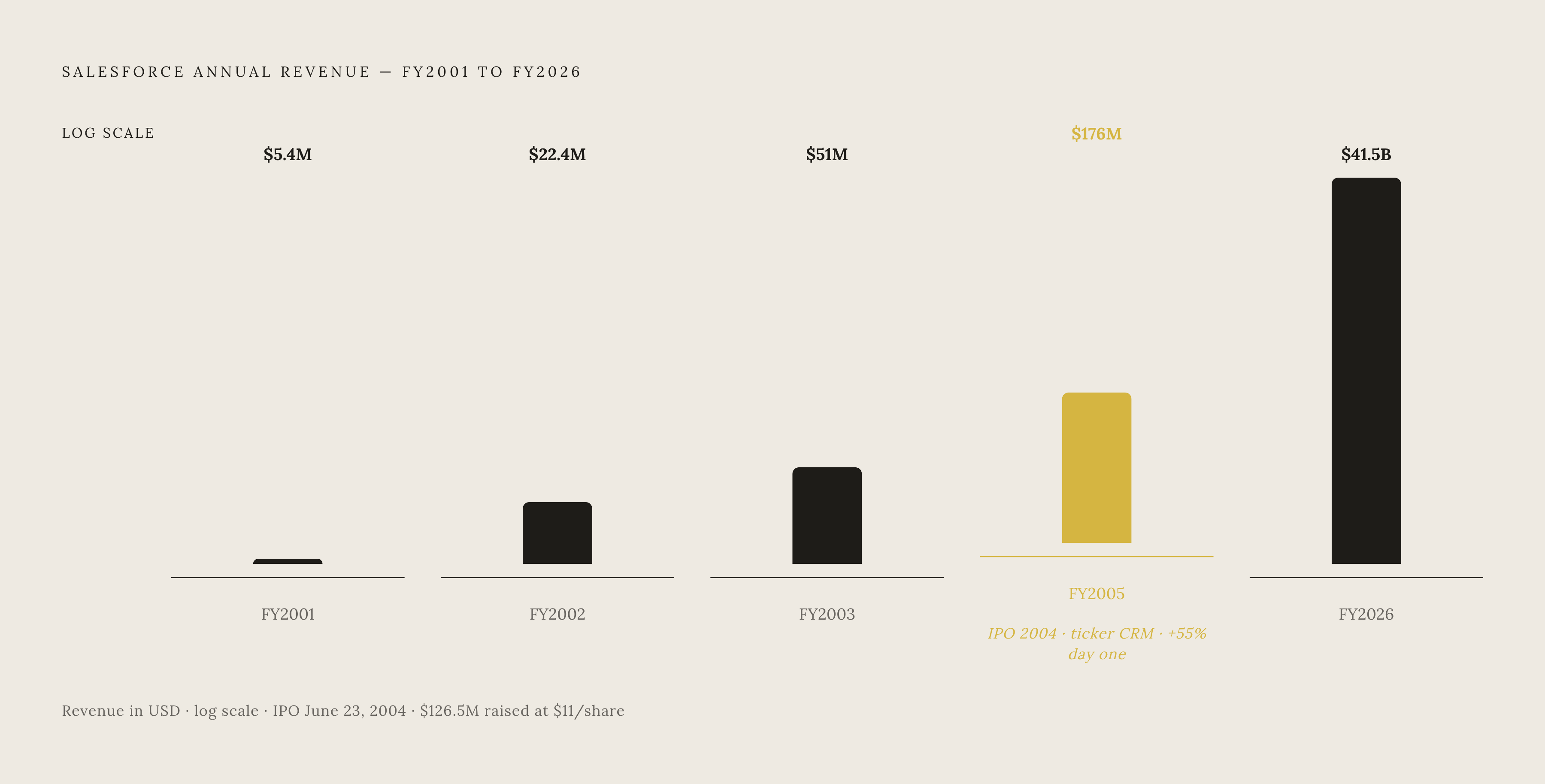
The revenue curve backs this up. From $5.4 million in the fiscal year ending January 2001, to $22.4 million the next year, to $51 million the year after that, growth was dramatic across that stretch. By the end of 2002, Salesforce had 5,740 customers and 70,000 users across 107 countries. Somewhere in there, "Salesforce experience" turned into a resume line item employers actively searched for. That's a network effect built on vocabulary as much as software.
The IPO ticker as the final act of category ownership
Salesforce went public on the New York Stock Exchange on June 23, 2004, raising $126.5 million at $11 a share. The stock jumped more than 55% on day one, a nice payday, but the real move was the ticker symbol.
Salesforce chose "CRM." Not "SFDC," the obvious shorthand for its own domain. Not "SFA," the old category label it had spent years trying to bury. The company staked its entire public identity on the category noun itself. Every financial terminal, every analyst note, every quarterly earnings headline from that day forward would repeat the same equation: Salesforce equals CRM. A ticker never stops broadcasting, and this one broadcasts a branding argument on every single trading day, whether the market's up or down.
By the time of the IPO, Salesforce had 13,900 customers, 767 employees, and 8,000 developers plus 150 independent software vendors building on its technology across 12 offices worldwide. Revenue for the fiscal year ending January 2005 came in at $176 million. Run the tape forward: $5.4 million in FY2001 to $41.5 billion in FY2026, all trading under the same four letters. That's the single most durable language move the company ever made, a permanent entry in a public, regulated ledger that nobody can quietly rebrand later.
Scaling the narrative beyond the product: Dreamforce, AppExchange, and the "Trailblazer" identity
The first Dreamforce happened in 2003 at the Westin St. Francis hotel in San Francisco: 1,300 registered attendees, 52 presentations, and the launch of sForce 2.0, billed as the industry's first on-demand application service. By 2018, attendance had climbed to roughly 200,000 people, making it one of the largest technology events anywhere, a narrative broadcast bigger than any ad budget could buy on its own.
AppExchange launched in January 2006, after a preview at Dreamforce the previous September. Benioff called it "the eBay of enterprise software," another borrowed metaphor doing the heavy lifting of making a new idea click instantly. By the end of that first year, Salesforce had 20,500 customers and nearly 400,000 unique users worldwide, with 575 apps built by 250 independent software vendors on the platform.
Building Force.com and becoming a platform, rather than building every application in-house, was as much a language move as a product one. Calling yourself a "platform" quietly reframes every competitor as a mere feature by comparison, which is a sharper insult than it sounds.
Then there's "Trailblazer," the name Salesforce gave its own customers. Not a throwaway nickname, a shared identity, a word customers use about themselves that happens to be inseparable from the Salesforce brand. Salesforce noticed plenty of people recognized the name but couldn't say what the company actually did. Trailblazer fixed that, a correction built directly into the community's vocabulary rather than into an ad campaign. Dreamforce, AppExchange, and Trailblazer serve three different constituencies: customers, developers, and partners, each handed a vocabulary that keeps them inside the Salesforce story even when nobody from Salesforce is in the room.
What the Salesforce story teaches about language as a structural asset
The lesson here runs backward from how most companies actually operate: language is not the last mile of a product launch, and it's the load-bearing wall. Most founders build the thing, ship the thing, then hand it to a marketing team to find some words for it. Salesforce did the opposite, and the order is the whole point. It named the enemy first (software), then the promise (the end of software), then the delivery model (on-demand, the cloud), then the community (Trailblazers), and only then claimed the category noun itself as a stock ticker. Language came before the product decisions and shaped them, guiding what came next.
Three levels of language ran at once, and none of them worked without the other two. Externally, "The End of Software" reframed how the whole market judged a purchase. Internally, the V2MOM and the laminated cheat sheet kept thousands of employees saying the same thing without a script in front of them. In the community, Dreamforce and Trailblazer let customers and developers carry the story forward on their own, unsupervised. Stripping out any one layer makes the other two weaker: an external slogan with no internal discipline behind it turns into empty advertising, and internal alignment with no external villain to push against just becomes a mission statement nobody outside the building cares about.
None of it works without the villain, though, and most companies skip naming an enemy out loud because it feels uncomfortable. Strip Siebel out of the story and "The End of Software" is a slogan floating with nothing to push against. The villain gave the whole thing contrast, urgency, and a reason for a buyer to actually switch vendors instead of just nodding along at a conference. Siebel, for its part, was still carrying the debt of an unsettled category name, a term Gartner is credited with coining around 1995, though Jagdish N. Sheth and Tom Siebel both get mentioned in other accounts of who said it first. Nobody had locked down what to even call this kind of software before Salesforce showed up and answered the question for everyone, on its own terms. Companies that skip this step and go straight to feature comparisons are playing a game they can't win against a bigger competitor, which is exactly the game Salesforce refused to play. That's the real moat here. Not the code. The words.