Series A Pitch Narrative Structure for Uncategorized Markets
Founders in uncategorized markets must build the category itself before proving they own it.

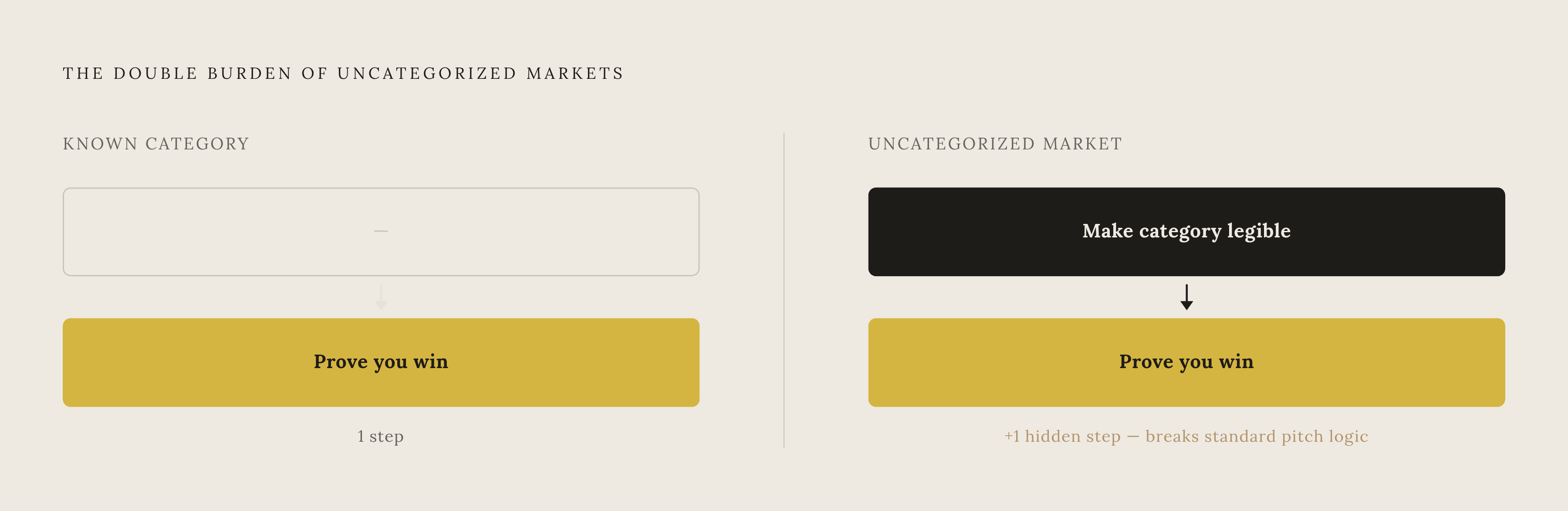
Most Series A decks are built on a bet: the investor already knows what category the company plays in, so the job of the pitch is just proving the company wins inside it. Lead with traction, show the wedge, close with the ask. That structure works fine when there's a shelf to put the company on.
The whole thing collapses when the shelf is stripped away. An investor staring at a company with no comparable and no incumbent to displace doesn't know how to weigh the metrics in front of them. An ARR number that would get a standing ovation in a known category gets a shrug here, because nobody's told the investor what it's ARR of.
This is why "put your best metric on slide two" is such dangerous advice once the market itself has no name. Numbers without context don't read as proof. They read as noise from a company nobody can place. And that's the real bind: founders in uncategorized markets are stuck doing two jobs at once, not one. First, make the category legible. Second, prove ownership of it. A standard deck was never built to carry both.
What makes a market "uncategorized" for pitch purposes
"Uncategorized" gets thrown around loosely, so a market is uncategorized, for pitch purposes, when there's no shorthand an investor can reach for. A market is uncategorized, for pitch purposes, when there's no shorthand an investor can reach for. No comparable company to cite. No incumbent to say "we're taking share from." No analyst report with a category name already printed on it.
That's a different animal from being early in a category that already exists, or being a disruptive player inside a market with an established reference point, or being "SaaS for veterinarians" (a known model, just a new flavor). All three of those have names already. The uncategorized condition doesn't.
This is a language problem before it's a market problem. The company is being mispriced because there's no word for what it is yet, even though the opportunity is large and the traction is strong. It's being mispriced because there's no word for what it is yet, and investors are bad at pricing things they can't say out loud.
Three patterns tend to trigger it. The company sits between two known categories and belongs fully to neither, so it gets partial credit in both and full credit in none. Or the company is solving a problem the market hasn't yet learned to name as a problem, meaning demand exists but the vocabulary for expressing it doesn't. Or the technology has simply outrun the language, moving faster than the market's ability to describe what it's looking at.
Naming the problem space before explaining the solution
The core move: name the problem before showing the solution. Not describe it. Name it, the way a category eventually earns a name of its own.
Why the order matters so much: investors pattern-match against labels, not descriptions. A well-drawn description hands them homework, cognitive work the rest of the pitch hasn't set them up to do. A name makes something click into place before you've even gotten to the product.
Naming the problem space, in practice, means three things. Give the underlying condition a term the investor's never heard but instantly nods at anyway, the "oh yeah, obviously" reaction. Frame it as a structural failure baked into how an existing system works; the first framing makes room for a new category, the second just makes room for a plug-in. And anchor the problem to a cost or consequence the investor can price in their head, even if it's rough and qualitative rather than exact.
Get this right and the problem name does something bigger than land a good slide. It becomes the seed of the category itself, the phrase the investor repeats to their partners on Monday when explaining why they're excited about a company that, on paper, doesn't compete with anyone.
Sequencing the origin of the category, not just the origin of the company
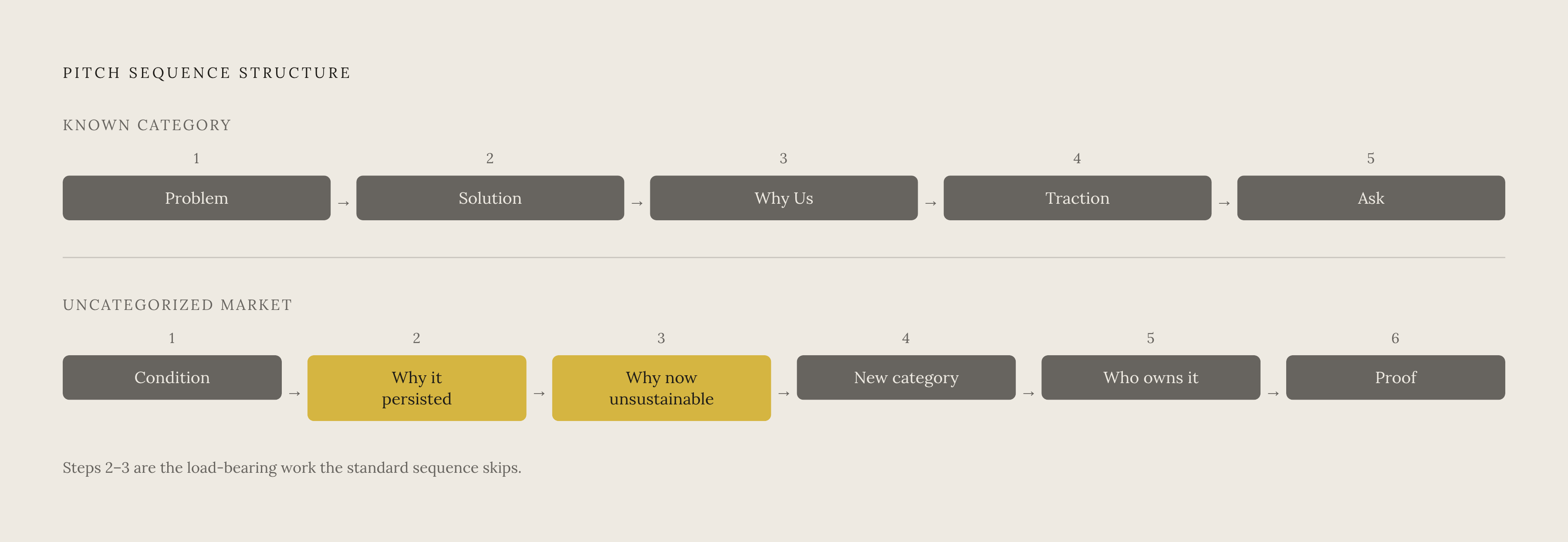
The familiar rhythm, problem, solution, why us, traction, ask, works because in a known category the investor fills in the market context automatically. If that scaffolding is taken away, the sequence has to do more structural work: condition, why the condition persisted, why it's now unsustainable, what the new category actually is, who owns it, and only then, proof of ownership.
The "why now" slide changes jobs entirely in this context. In a known market, "why now" answers a competitive question, why this team, why this moment relative to rivals. In an uncategorized market, "why now" has to answer a bigger question: why is a category forming at all, right now, for the first time. That means naming the structural, technological, or behavioral shift that made the old way of doing things finally break.
Treat the category's origin as a narrative asset in its own right, separate from the company's founding story. Showing that the conditions creating this market have been building for a while, quietly, in the background, makes the whole thing feel inevitable rather than clever. Nobody wants to fund a clever idea. They want to fund a freight train that's already left the station.
Building the category frame investors will use when you leave the room
Most Series A deals don't die in the room with the founder. They die two days later in a partner meeting the founder never sees, where someone tries to explain the company to three skeptical people and fumbles it. If the story survives that retelling, the deal has a pulse. If it doesn't, it's over and nobody even bothers calling to say so.
A tagline can't survive that room. Neither can a punchy one-liner about "disrupting" something. What survives is a category frame: a short, structured explanation of the new market that a partner can repeat with reasonable accuracy without the founder standing there to patch the holes.
A frame that travels has four parts. A name for the condition (already established when the problem got named). The structural reason existing solutions can't actually address it. The defining trait of the new category, the thing that separates a real player in this space from something merely adjacent to it. And the company's specific claim to owning that defining trait.
Building this is a design decision, not an afterthought, because the pitch itself was never the actual decision point. It's the briefing document for an advocate who's about to go fight for the deal without any backup. If the frame falls apart on the retelling, so does the advocacy, and so, generally, does the term sheet.
Sequencing traction evidence so it reads as category proof, not isolated performance
Traction without a category frame reads as interesting trivia, not proof of anything. The investor can't tell if strong numbers point to a big market forming or a lucky edge case that happened to work once.
Reframe what traction is actually evidence of. It's proof the category is forming. That single shift changes which numbers matter and the order they get shown in. Each data point needs its context delivered first, so it lands as category evidence rather than a company brag.
Customer selection matters more than customer count. The specific companies who bought are exactly the early adopters you'd expect to appear first if a new category were actually forming, so don't just list logos. Retention tells a similar story: net revenue retention above 120%, a threshold cited from waveup.com's survey of 52 Series A funds, is evidence buyers are going deeper into the category in this context. It's evidence buyers are going deeper into the category, kicking the tires on more than a novelty. And deal velocity, sales cycles quietly getting shorter, signals the market is starting to recognize the category on its own, without a founder explaining it fresh every time.
This is why leading with ARR on slide two backfires here. The standard advice assumes the investor already knows what category a $3M ARR business belongs to. If that assumption is stripped away, the number just floats there, impressive and homeless.
Handling the "market size" slide when no analyst has sized your market yet
The classic TAM slide needs a source, and there isn't one. No analyst has drawn a box around this category yet, so there's no credible top-down number to cite. Making one up is worse than leaving it blank; a fabricated TAM gets sniffed out fast and it costs more credibility than an honest gap ever would.
Investors are actually asking "can this return the fund," not "how big is this market."" They're asking "can this return the fund." The market size section's real job is answering that second question through a side door, since the front door's locked.
Three routes tend to work. Adjacent market displacement: size the existing behavior the category is going to replace, not a neighboring product, but the actual budget line, the money already being spent badly, that the new category will eventually absorb. Bottom-up from observed buying: real contract sizes, real expansion rates, real buyer profiles, stitched into a credible picture of what the market is already producing on the ground. And category formation precedent: point to how a comparable category came together in the past, how long it took before analysts caught up and gave it a name, and what that market looked like at this same early stage.
None of this is really a data slide. It's the moment an investor gets shown why this category, once it has a name and gets recognized as real, pulls in the capital concentration that produces the fund-returning outcome they're actually chasing.
The category ownership claim: how to assert it without overstating it
Saying "we're defining this market" out loud is close to the weakest way to make the point. Ownership has to get demonstrated through the structure of the story, not asserted as a slogan somewhere in the deck.
Three signals carry real weight. The company named the problem before any competitor got around to describing it, proof the founder's frame is already shaping how buyers talk about their own situation. The company's specific language appears, unprompted, in how customers describe their own problem, a citable, concrete sign the frame is spreading on its own steam. And the company has made architecture decisions that only make sense if this category exists, a level of commitment competitors haven't matched because they're not fully convinced the category exists yet.
Category creation means defining a new segment around a problem the product solves, so buyers end up comparing the company to the old, broken way of doing things, not to a lineup of rivals. That distinction rewires the entire competitive frame, so it needs to be stated in the pitch.
Which raises the question: who else is doing this? A competitor slide is the wrong answer. A quick tour of the fragmented, half-working responses currently out there, the patchwork the newly named category is the first thing to make coherent, is the right answer.
Language precision in the pitch and its effect on company pricing
In an established category, price gets anchored to comparables. Investors reach for multiples they've used a dozen times before, nudge them up or down for growth and retention, and call it a day. The pitch's language just polishes that number; it doesn't set it.
None of that scaffolding exists in an uncategorized market. There's no multiple sitting on a shelf waiting to be applied, because there's no comparable to borrow one from. Which means the language of the pitch isn't decoration here, but the pricing mechanism itself. The name given to the problem, the frame built for the category, the ownership signals laid out along the way, all of it stands in for the comparables an established market would have supplied for free.
Loose language in that vacuum doesn't just read poorly. It leaves the investor pricing on vibes, or worse, pricing against the nearest known category, however bad the fit, just to have a number to write down. Precise language gives them something sturdier to price against: a category that's new, but legible, with a company that's clearly first in line to own it.