How Notion Displaced Confluence by Reframing the Knowledge Management Category
Notion won by persuading buyers they needed one workspace, not the best wiki.
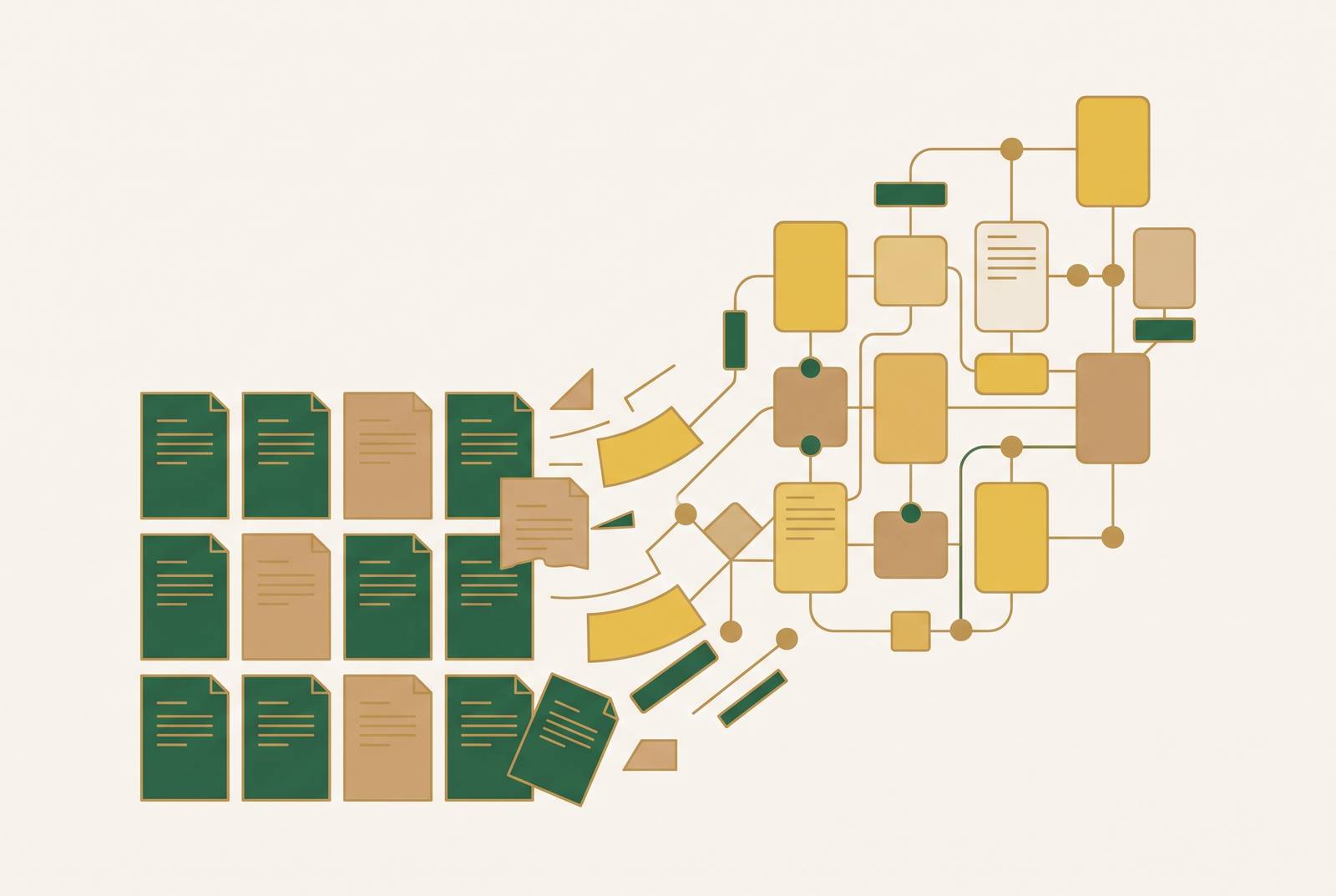
Notion displaced Confluence in parts of the market not by building a better wiki, but by changing what buyers thought they were buying. “All-in-one workspace” turned a contest between knowledge tools into a judgment on the whole software stack. Its success, and its limits, show that a category claim must change what buyers look for in a purchase and have a product capable of providing it.
Why the productivity tool market was ripe for a category reframe
By the early 2020s, productivity software had a coordination problem disguised as a collection of useful tools. Each application handled a particular job, but work crossed the boundaries between them. People switched contexts, searched across platforms, navigated inconsistent permissions, and learned another system whenever another tool arrived. The hidden tax was visible in lost productivity and weakened trust, costs an invoice could not neatly capture. The tools had specialized, but the work had not agreed to stay in its assigned boxes.
That mismatch created an opening a feature war could not address. A better wiki could make documentation better while leaving the rest of the stack just as scattered. Each incumbent defended its own patch of the market. No incumbent had named fragmentation across tools as something to solve by redefining the category and offered to do so.
Buyers could see the hassle, but the categories on offer led them to judge each tool on its own. Whoever named the common problem could also define what a complete solution should look like. That would change not just the sales pitch, but the field of competitors. The opening belonged to a company that could make consolidation understandable and credible at the same time.
How Notion's founding architecture encoded the category claim before any marketing did
Notion’s block-and-page architecture gave consolidation a concrete form. Its modular system allowed a block to become a page, a database, a task, or a doc. Those were not merely different features placed under one logo. They expressed the same product thesis, namely that a flexible system could take the place of a stack of single-purpose tools. The architecture was an argument buyers could use.
But flexibility alone was not enough to make that argument clear. Notion’s first iteration in 2015 failed because users could not readily understand it, and the company nearly ran out of funds. The founders reduced the team to two people and rebuilt the product in Kyoto, Japan. A system that could do many things still had to make sense to the person opening it.
The rebuild distinguishes this case from rebranding. Notion could not simply rename a confusing product and expect the new category to carry it. The user experience had to show how different kinds of work fit together. Its positioning was earned through restraint. Product and language were two expressions of the same decision, with neither able to do the other’s job.
What "all-in-one workspace" actually did as a category frame
“All-in-one workspace” changed the unit of comparison. A buyer looking for a better wiki would compare Notion with Confluence, feature by feature. A buyer looking for an all-in-one workspace would compare Notion with the entire collection of tools already in use. The phrase moved the decision from which application performs one job best to whether separate applications are the right arrangement at all. That shift happened before the spreadsheet opened.
The wording carried its own diagnosis. “All-in-one” only promises something valuable if the alternative is fragmented, so it implicitly challenged Confluence, Jira, Trello, and Docs without naming them. “Workspace” then offered a place where work belonged together, rather than another destination for one kind of information. The stack became the problem under review. Notion no longer had to win every separate contest to make a compelling case.
This also changed the meaning of its limitations. Notion fell short of best-in-class at some jobs, but it sold the experience of doing those jobs together in one place. A depth comparison could therefore answer a narrower question than the buyer now cared about. Its multi-category position created a “category of one,” difficult to classify as merely a wiki, a doc tool, or a project manager. The checklist had not disappeared, but someone had changed its heading.
The strongest objection is that product-led virality drove adoption and messaging followed. Yet the architecture needed a portable explanation for its flexibility to spread. Early adopters could explain it as “it replaces all your other tools,” which describes a category claim. The language made the product’s breadth legible, while the product gave the language proof.
How Confluence's own language locked it inside the category Notion was dissolving
Atlassian’s own comparison page shows the shift in competitive terms. It positions Confluence through governance, compliance, FedRAMP, RBAC, data security policies, the Teamwork Graph, and Atlassian agents. These are substantial claims about enterprise needs. But they answer a broader question about how work and knowledge should fit together. They defend a different kind of consolidated system.
That is a meaningful departure from “enterprise wiki.” The older frame is clear and defensible, but its central metaphor is storage. Information goes in and is retrieved when needed, making the value sound archival. A filing cabinet is useful, but nobody mistakes it for the office. Once buyers want a workspace, excellence at storing information can sound like only part of the answer.
Atlassian surfaces that broader answer through Juan Carlos Pin, Jira Admin, who says, “Notion worked well when we were smaller, but as Pluxee grew, we needed something that could scale with us. Confluence gives us one source of truth that keeps everyone aligned”. Confluence is reclaiming the vocabulary of a unified knowledge system on its own terms. The incumbent’s response shows the effect of the reframe, because the argument now takes place on the challenger’s chosen terrain.
Where the displacement is real and where it stops — the actual market split
Small businesses make up 66.4% of Notion users, while enterprise-segment adoption remains a small fraction of its base. Its category frame took hold among startups and growing companies that were choosing their tools. It made less headway in engineering-led enterprises where Confluence came through an existing Atlassian commitment. A persuasive new buying question matters less when the purchase is already attached to another decision.
The strongest objection to the displacement thesis is therefore correct for an important segment. A team running Jira at scale has integration and governance needs that a category phrase cannot dissolve. Confluence’s structural position rests on Jira dependency and enterprise contracts. Notion holds teams more through how they use it, because the more they customize their workspaces, the harder it gets to move away. Both create switching costs, but they fasten the buyer to the product in different ways.
This distinction narrows the claim without emptying it. Notion changed the contest where buyers could rethink the whole stack. Its substantial annual cost per buyer also complicates any reading of “all-in-one” as a bargain promise. The appeal was premium consolidation. The strategic advantage was control over how buyers evaluated a purchase, without a guarantee of winning every purchase.
The governance paradox Notion's own frame created
The flexibility that made Notion’s promise credible could also recreate fragmentation inside the workspace. New content could outpace review, organizational changes could leave documentation without an owner, and uncontrolled database duplication could scatter knowledge. One roof can still hold several junk drawers.
This is where knowledge debt becomes language debt. Orphaned pages, broken database links, and conflicting versions leave people unsure which account of the work is authoritative. In ungoverned deployments, the ability to duplicate and alter core database views can let critical onboarding workflows and compliance documents shift without an auditable trail. The permission model described in the brief does not supply the governance required for zero-trust compliance audit contexts. That limits what consolidation alone can promise.
The category frame implies a maintained system, while the tool does not enforce maintenance. A human or team must govern the canonical version of each document, including what remains authoritative and what should be retired. Buyers adopting the workspace frame therefore also need a governance discipline. Without it, they have bought the language of coherence without the infrastructure that keeps it true.
How Notion's AI bundling converts the workspace frame into an operating system claim
Notion took its category claim further when it removed the standalone AI add-on in May 2025. AI became part of what the workspace offered, so the case for an upgrade shifted from what it cost to what it could do. The frame could now move from “flexible workspace” toward “AI operating system.” That is a larger promise than keeping work together. It makes the knowledge system the base for work that agents do.
Notion’s official release page dates Notion 3.0 to September 18, 2025, and its announcement states, “Today we launched Notion 3.0 with Agents”. Notion’s official release notes then place Custom Agents in Notion 3.3 on February 24, 2026. The April 2026 developer preview extends that sequence. Together, these releases show the pace and direction of the category expansion. The workspace was becoming the basis for a claim about how work runs.
That raises the cost of unclear knowledge. AI agents work from the knowledge base they are given, so what they do depends on which content is canonical, retired, or authoritative. Confusion is no longer only something a reader encounters. It becomes part of the material an agent works from. Governing language therefore helps govern what the AI does.
Atlassian’s comparison page makes a strong counterargument through context. It positions the Teamwork Graph as connecting Confluence, Jira, and 100+ third-party connectors, and says Atlassian customers invoke agents millions of times a month. Its argument is that an integrated ecosystem gives AI more context than a standalone workspace. That gives Confluence’s strengths in governance and its ecosystem a bigger role. The next contest is not workspace against wiki, but whose knowledge layer the AI runs on.
What the Notion–Confluence contest teaches about category reframing as a language strategy
Naming a category changes the decision before it changes market share. Notion connected an unnamed structural frustration to a product architecture and gave that connection a phrase buyers could repeat. The product made the category plausible, and the category made the product understandable. A feature advantage could have won a comparison, but this move changed the comparison itself.
For founders and platform companies whose technology is ahead of the market’s vocabulary, precise naming is therefore a structural task. Founders and platform companies need to identify which existing comparison prevents buyers from seeing the product’s value. A credible new frame must identify a real problem and make clear why the old categories leave it unresolved. Otherwise, it is just a new label asking for a larger budget. Companies that leave the naming to others accept someone else’s terms of evaluation.
But a category claim also creates an obligation to maintain what it promises. Storied’s Narrative OS and Narrative Intelligence work address that gap by architecting the canonical language layer a category claim needs at scale and governing it so AI amplifies clarity. Language is not only how a company explains its system, but part of how the system stays coherent. A durable category strategy changes the buyer’s terms, then builds the governance needed to keep the promise.