How Snowflake Defined the Cloud Data Platform Category
Snowflake built a market by inventing the language to describe what it made possible.
The real story of Snowflake is the dictionary. It's the dictionary. Every time the company hit a wall the market had no words for, it built new words first and let the product catch up in the public's mind. That's the whole playbook, repeated three times, and most people telling this story get the order backwards: they think the tech won and the naming just rode along for the press release. It's the opposite: the naming is what let the tech win, not the other way around. The naming is what let the tech win.
Back in 2012, enterprise data infrastructure was defined by rigid, on-premise constraints. Data warehouses lived on-premise, and compute and storage were bolted together like a cable package you couldn't split up. Want more processing power? You were required to buy the attached storage too, regardless of need. Scaling meant a purchase order and a wait. Concurrent workloads fought each other for resources, and everyone treated that as just the cost of doing business, the way you accept that the office printer jams the one day you actually need it. Semi-structured data (JSON, XML, the messy stuff modern apps actually produce) was never a first-class citizen in those systems.
Every word available to describe this stuff (warehouse, fixed capacity, hardware provisioning) already assumed the old constraints. Try describing a genuinely elastic, cloud-native system using vocabulary built for a box bolted to a rack in a server room. It's like describing the internet using vocabulary built for the postal service: technically possible, but every sentence quietly drags the listener back to the wrong mental model. That's language debt. At the market level, it holds real innovation hostage for years, because if buyers, analysts, and investors have no words for the new thing, they price it like the old thing, forever, or until somebody hands them better words.
The architectural decision that made a new category possible
Snowflake was founded on July 23, 2012, in San Mateo, California, by Benoît Dageville and Thierry Cruanes, both former data architects at a large enterprise software vendor, along with Marcin Żukowski, who'd co-founded Vectorwise. This team didn't guess at what was broken. They'd spent years inside the old architecture and knew exactly where it creaked, which is a very different starting point than an outsider with a whiteboard and a hunch.
Their bet was simple to state and brutal to execute: cloud computing didn't just make things cheaper, it detached software from the specific hardware running it. Once you accept that, coupling compute and storage tightly stops looking like an engineering necessity and starts looking like a historical accident nobody bothered to fix. So Snowflake made the one decision that unlocked everything else: separate compute from storage completely, no compromises, so each could scale on its own.
The payoff was visible fast, in concrete terms, measured directly in cost and usage. A team could spin up massive compute for one gnarly query, then shut it off and stop paying, the way you'd rent a moving truck for moving day instead of buying a truck you'll use twice a year. Multiple teams could run workloads at the same time without stepping on each other's toes. And structured data could finally sit next to semi-structured data in the same service, instead of living in separate systems that never talked to each other.
Snowflake's 2016 technical paper (which picked up the 2026 SIGMOD Test-of-Time Award, a nod to how well the ideas held up) laid out three founding principles: bring all data together in one place without sacrificing SQL or transactional integrity, lean into cloud elasticity instead of fighting it, and make the whole thing simple and easy to use. The company stayed in stealth mode until October 2014. By then, 80 organizations were already using it, quietly, while the market outside still had no name for what it was looking at.
Naming the break: how "separation of compute and storage" became a market-orienting phrase
A breakthrough nobody can describe is a breakthrough nobody can buy. Snowflake needed a phrase, and "separation of compute and storage" turned out to be the right one. Four words, deceptively plain, and they did something no existing term could manage: they named the exact constraint every competitor was still hauling around like a ball and chain.
The phrase worked as a category signal for a few clean reasons. Technical buyers who'd lived with coupled systems for years recognized the pain instantly, no explanation needed. It also indicted the competition without naming a single rival, a neat trick if you can actually land it. And it gave analysts and investors a one-sentence answer to the question that a pitch meeting hinges on: what's actually different here?
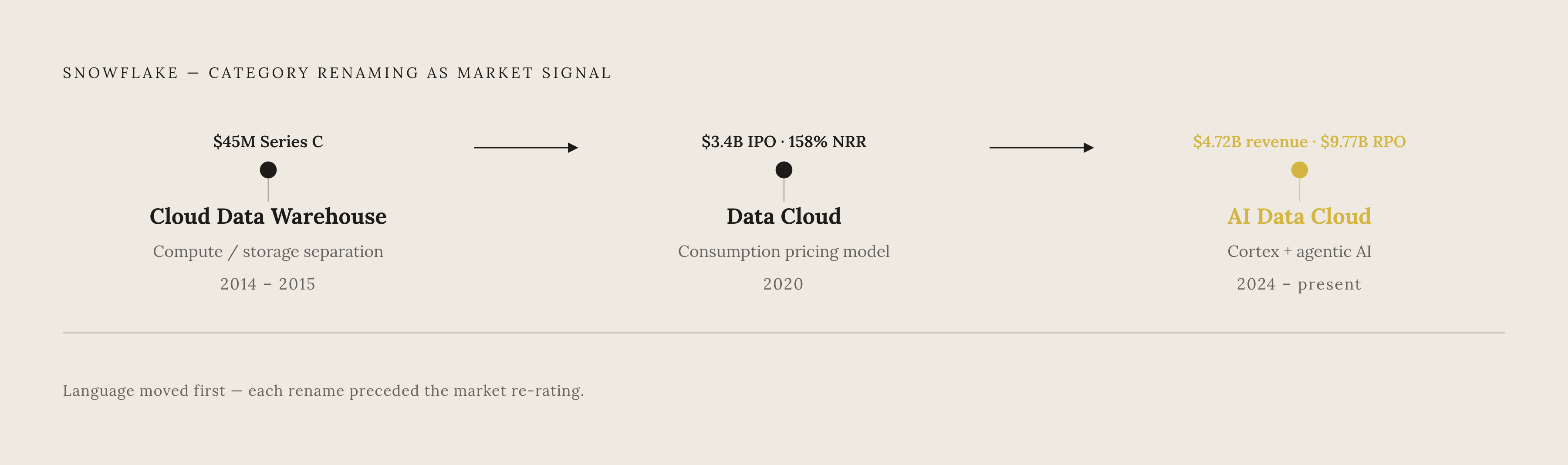
Early on, Snowflake called itself a "Cloud Data Warehouse," a label that kept one foot in familiar territory (warehouse) while planting the other in new ground (cloud, separation). The product launched in June 2015 into a market still speaking the old dialect, and investors came along anyway: a $45 million Series C in October 2015, then a $100 million Series D in 2017. That conservative naming choice wasn't timid, it was deliberate. Meet buyers where they already stand, then let the architectural phrase do the real work of setting Snowflake apart from everyone still selling boxes. The job of early category language is to make the old world feel just slightly obsolete, and "separation of compute and storage" managed that without ever raising its voice.
Frank Slootman's arrival and the organizational narrative that preceded the IPO
Frank Slootman became CEO in May 2019, with a resume built entirely on narrative-driven scaling. He'd taken ServiceNow from roughly $100 million in revenue through IPO to a figure several times larger, and before that steered Data Domain from startup through IPO to an acquisition by EMC worth several times its revenue. This was not his first rodeo, or even his second.
His operating doctrine, later written down in Amp It Up (published January 2022), boiled down to one organizational language rule: raise the pace and intensity of execution and get everyone aligned around a single story. At Snowflake, that meant driving everyone toward a single shared story, erasing the internal dialect of personal targets that usually splinters a company's focus into a hundred private agendas.
His arrival came with an explicit mandate to raise ambitions company-wide and drive toward an outsized outcome. His "go direct" principle let anyone cut across hierarchy to solve a problem, which structurally means information moves fast and doesn't get filtered into departmental dialects along the way.
Revenue sat around $97 million when Slootman walked in. No company sustains a category-defining external story if the internal organization is running on fragmented language, and the internal alignment he forced into place became the engine behind 173% revenue growth in the fiscal year leading up to the IPO. Slootman fixed the story inside the building before he ever tried to sell it outside.
The 2020 IPO as a narrative stress test Snowflake had to pass
Snowflake went public on September 16, 2020, raising roughly $3.4 billion, the largest software IPO at the time. Shares priced at $120 and opened at $245, more than double the offering price, putting the valuation around $33.2 billion. Big number. But the harder problem wasn't the size of the raise. The shape of the revenue was the harder problem.
Public markets had only ever known how to price enterprise software one way: annual recurring revenue, booked predictably, year after year. Snowflake's consumption model didn't work that way. Revenue got recognized only when customers actually burned through their credits, even under multi-year contracts, which meant Snowflake had to invent a new valuation language at the exact moment it needed investors to trust the old one wouldn't apply. Net revenue retention of 158%, the highest of any public cloud company at listing, became the single proof point that consumption-based growth was more durable than ratable SaaS, not less predictable, despite looking messier on a spreadsheet.
Then Warren Buffett showed up. Berkshire Hathaway agreed to buy $250 million in Snowflake stock through the IPO, privately, marking Buffett's first IPO investment in 64 years. A notoriously tech-skeptical investor putting real money into a data platform is the kind of signal no analyst report can manufacture on its own. Even the S-1 filing did narrative work: defining what a "customer" means under consumption pricing, or what "remaining performance obligation" means when revenue isn't ratable, wasn't legal boilerplate. Those definitions were infrastructure. The IPO proved narrative work isn't just for customers. It has to be legible to every audience gating the next stage of growth, including public investors showing up with zero prior vocabulary for the category they're being asked to buy into.
The "Data Cloud" rename, retiring "warehouse" and claiming a higher-order category
In 2020, right around the IPO, Snowflake dropped "data warehouse" as its primary label and picked up "Data Cloud" instead. The timing wasn't an accident. Public markets got a forward-looking frame instead of a legacy one, right when it mattered most.
The rename wasn't cosmetic. It was structurally necessary. "Data warehouse" put a ceiling on how big the platform could seem, implying storage and query and not much else, and worse, competitors could credibly call themselves data warehouses too. Nobody else could credibly call themselves "the Data Cloud," because Snowflake had just claimed the term for itself. The new frame also swallowed adjacent categories whole: data lake, data exchange, data applications, data science, data engineering, all of it fit comfortably inside "Data Cloud," which made Snowflake's territory bigger than any single competitor's turf.
"Data Cloud" also smuggled in a network-effect story: the platform gets more valuable as more organizations share data across it. That's a fundamentally different pitch than "better warehouse." It's a platform story, and platform stories get platform multiples. Every rename like this resets the battlefield, too. Competitors who'd spent years positioning against "data warehouse" suddenly had to respond on Snowflake's chosen ground, either adopting the new language (which validates the category) or rejecting it (which just makes them look smaller by comparison). By fiscal 2025, Snowflake served more than 10,000 customers, and at that scale, the customer list was proof the category claim had been real all along.
The consumption model as narrative made structural, how language clarity converts to automatic revenue expansion
Snowflake books revenue only when customers actually consume credits, unlike the ratable SaaS model most software runs on. That single design choice changes what "success" means for a sales rep. The focus shifts to creating use cases that keep customers coming back to spend more, quietly, month after month. It's about creating use cases that keep customers coming back to spend more, quietly, month after month.
Organizationally, that split the sales force in two: one team lands new customers, a separate team grows existing accounts. As the internal saying reportedly goes, the team that closes the deal is off it the moment it closes. Growing an account takes an entirely different kind of storytelling than landing one in the first place, and Snowflake built the org chart around that distinction on purpose. Between 2021 and 2022, sales headcount grew from 1,257 to 1,891, yet sales and marketing spend as a share of revenue actually fell, from 81% to 61%. Growth went up while the cost of getting it went down, a form of leverage that appears when the underlying story is doing some of the selling on its own.
The land-and-expand pattern is really a narrative proof point wearing a business-metrics costume. When customers actually understand what they bought and why they'd want more of it, expansion happens through use, not through another round of reselling. Snowflake Summit has grown into a major annual gathering, which makes the event less a trade show and more an annual ritual of reminding the market what category it's standing in. A business model that depends on customers making small decisions to spend more, over and over, needs narrative clarity to stay switched on permanently. The story can't be a launch-day event. It has to run every day, quietly, in the background, like a pilot light.
The "AI Data Cloud" rename, how Snowflake ran the category-creation playbook a second time
Same move, second act. A new architectural reality, AI workloads running directly against enterprise data, needed a new category frame before some competitor got there first and installed their own.
Cortex, launched in 2024, embedded generative AI services (LLMs, vector search, model deployment) directly into the platform, accessible through plain SQL or Python. That kept the AI story tethered to Snowflake's original argument: keep the compute close to the data, no matter what kind of compute it turns out to be. Bigeye reports that Snowflake Intelligence reached general availability in November 2025, offering an enterprise AI assistant that answers natural-language questions across structured and unstructured data, built with agentic AI, governance controls, and MCP support baked in. Then Snowflake Summit 2026 brought AI agent governance infrastructure and a rebrand of the core AI product line, positioning Snowflake as the governed platform of choice for agentic AI, the kind enterprises can actually trust with real workloads instead of demo-day toys.
The numbers backed the new frame up. Wikipedia reports that Q4 fiscal 2026 product revenue hit $1.23 billion, up 30% year-over-year, with full-year product revenue at $4.72 billion. Remaining performance obligations reached $9.77 billion, up 42%, and over 9,100 accounts were actively using Snowflake's AI features.
The company also swapped leaders mid-story. Slootman retired on February 27, 2024, handing the CEO role to Sridhar Ramaswamy, co-founder of Neeva. That's a shift from a sales-driven era to a product-driven era built around one model, and it meant reframing the same underlying platform under new language without torching the enterprise trust built up under the old one. Investors tracking the language moves, warehouse to Data Cloud to AI Data Cloud, got an early read on each re-rating before the product releases even landed. The language moved first. The multiple followed after. The logic behind Cortex and Snowflake Intelligence is the original architectural thesis wearing a new hat: bring AI to the data. Separation of compute and storage, restated for a world where the compute in question happens to be a language model.
Language as structural strategy in the Snowflake arc
Lining up all three phases, Cloud Data Warehouse, Data Cloud, AI Data Cloud, the pattern gets hard to miss, and it argues against the lazy read that this was all just clever marketing. Every rename followed a real architectural change first. The language was never dressed-up hype riding on nothing; it came second, earned by the engineering that produced it first. Every rename also made the category bigger instead of just repositioning inside an existing one, forcing competitors to respond on Snowflake's ground instead of their own. And every time, Snowflake retired a limiting term before a rival got the chance to claim it for themselves.
That's the language-debt lesson in miniature. Snowflake's founders didn't just engineer something new. They diagnosed which words were quietly smuggling in old assumptions, and they refused to keep building inside that vocabulary. That refusal, on its own, was a strategic move worth more than most of the roadmap.
The category-creation lesson runs alongside it: whoever installs the vocabulary first wins the category before the competitive landscape even has time to organize itself around an alternative, and most competitors still miss this. "Data Cloud" was never just a label for what Snowflake already was. It was a bet on what the whole category would become, stated with enough confidence that the market eventually caught up and agreed with it. From a stealth startup with no market vocabulary in 2014, to a company teaching public investors a new way to price revenue in 2020, to a platform rewriting its own story for the AI era, the architecture came first every time. The words are what made it visible, and visibility, in a crowded market, is most of the battle.