Category Creation as a Venture Return Thesis at the Fund Level
Funds win by controlling how markets talk about their bets, not just by picking winners.

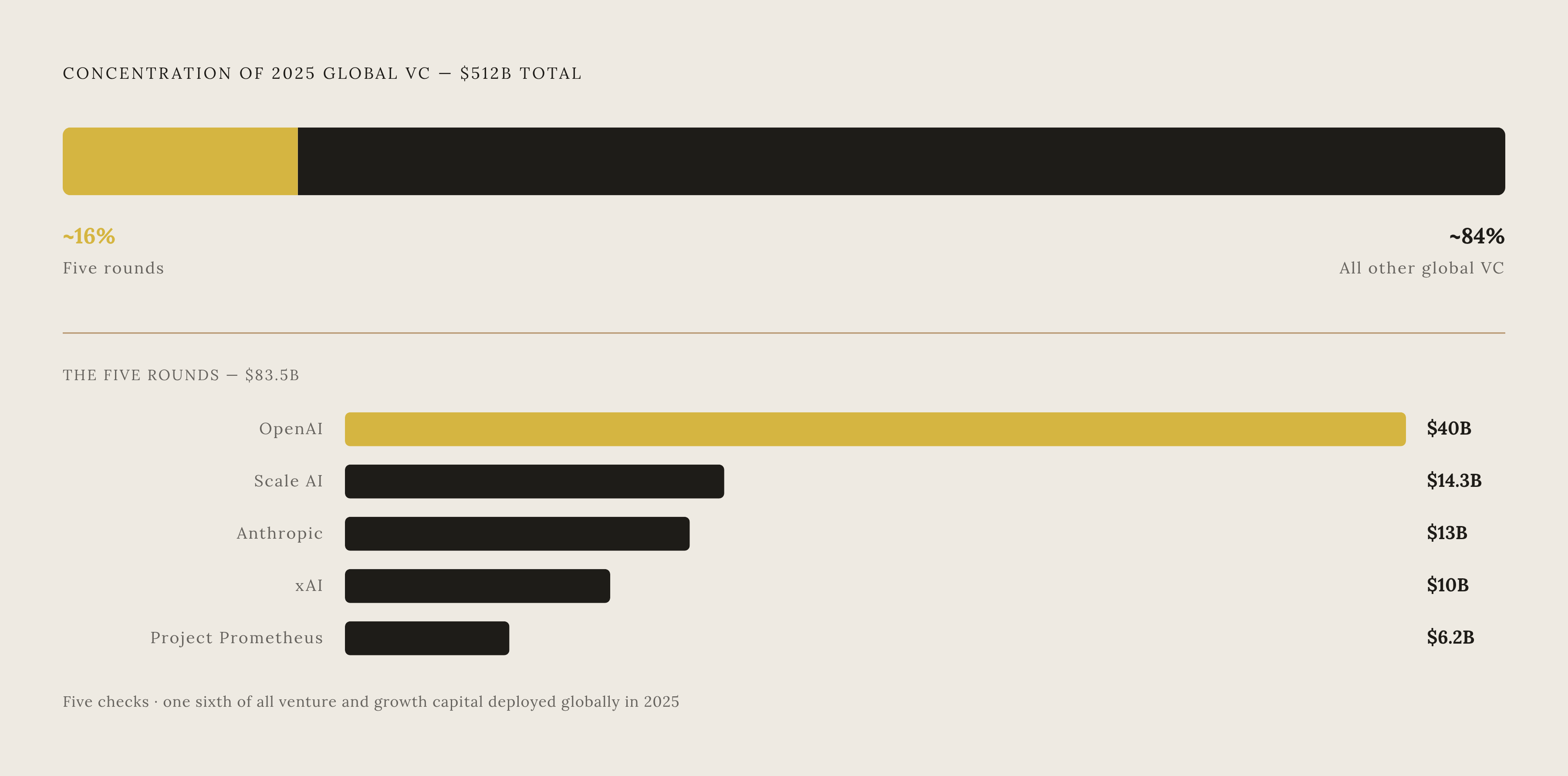
The market is splitting between exceptional companies that attracted massive capital and the rest competing for shrinking share: global VC investment rose from $391.9 billion in 2024 to more than $512 billion in 2025, yet total transactions fell 1.84%, from 45,861 to 45,019 Venture Capital 2026 — Chambers and Partners. Translation: more money, fewer bets, and the money is piling onto fewer names. Five rounds alone, OpenAI's $40 billion, Scale AI's $14.3 billion, Anthropic's $13.0 billion, xAI's $10.0 billion, and Project Prometheus's $6.2 billion, added up to something like 16 percent of all global venture and growth capital deployed in 2025 Venture Capital 2026 — Chambers and Partners. That's five checks eating a sixth of the entire market's oxygen Venture Capital 2026 — Chambers and Partners.
AI companies took 65 percent of all venture deal value last year, up from 46 percent the year before Magistral Consulting. Everyone calls this a "flight to quality." It's really a flight to whoever looks like they own the category, which is a different thing entirely Magistral Consulting. And the return data backs up how brutal this has gotten: VCs put over $200 billion into U.S. startups in 2024, average returns are around 12 percent, but 95 percent of all that return goes to just 5 percent of investors Harvard Business Review. That's not a power law flattening out with maturity. That's a power law getting more extreme.
The standard explanation for why some funds are in that top 5 percent is deal selection: better technology, spotted earlier, backed harder Harvard Business Review. Fine, sure, that's part of it. But it misses the mechanism that actually separates the winners: the ability to control how a market names, understands, and eventually prices what's been built. Picking well matters. Shaping the vocabulary the entire market uses to talk about your bet is the piece almost nobody builds on purpose.
The economics of "category creation" and where the standard pitch overstates it
If there's no existing comparison set, there's no competitor to lose to. Buyers have to decide the category is worth thinking about before they can even start comparing vendors, so the fight moves from "why us over them" to "why this matters at all."" That's a fight against inertia, not against a rival's sales team.
Except category creation is expensive, and pretending otherwise is how funds lose money believing their own pitch decks. For a company without deep pockets or perfect timing, that's not a strategy, that's a slow-motion cash bonfire⟧c7⟦. Add in customer acquisition costs running around $2.00 for every $1.00 of new ARR, and selling into a budget line that already exists starts looking a lot smarter than convincing a market a new budget line should exist Apricot Studio. That's a real constraint. Not a footnote.
Cursor is the case that breaks the simple version of this story. No invented category. No new noun for the market to learn.
So "create a category" was never the actual lever. Narrative control was. Cursor didn't need a new label because it governed the sentence the market used to understand the product: the same editor, just with better AI baked in. That's narrative ownership achieved inside an existing category, which means the real question for a fund isn't create-versus-enter. It's whether the fund controls the language the market uses to talk about what it built, regardless of which door it walked through. Category creation is expensive, and honest treatment of the counterargument shows that Drift, Gong, and Datadog each burned $50M+ before payback, per industry analysis, making it a cash-burning trap for companies without the capital cushion or market timing to sustain that Institute PM. The Cursor counter-example entered the world's most mature software category (code editors, where VS Code had more than 70% market share) and reportedly crossed $500M ARR faster than most category creators at comparable scale, without inventing a category name Institute PM.
The valuation gap that narrative control produces for fund returns
That's a structural divide. That's one group of companies getting priced like the future and another group getting priced like a commodity, in the same asset class, often selling into the same buyers.
Growth rate and product quality explain some of that spread, sure. The gap encodes something else: a narrative premium, the market repricing companies that own a category against companies still competing inside one McKinsey. Forbes and TrueBridge's look at the state of venture capital heading into 2026 backs this up from another angle: category leaders, especially the ones with real AI differentiation, set the pricing benchmark for entire funding stages, not just for themselves. Own the category, and everyone raising in your wake gets priced relative to you.
For a fund, this math is unforgiving in a specific way. If your portfolio companies are at 5x because they're competing in markets someone else defined, no amount of board seats, intros, or operational support closes that gap McKinsey. The gap didn't come from operations. It came from narrative, and it only closes through narrative. A fund that's actually built to move companies toward that 24x band, by governing how the market names and understands what those companies do, is running a fundamentally different return strategy than a fund that just picks quality companies inside the 5x band and crosses its fingers for a re-rate. Narrative alone doesn't get you to 24x McKinsey. Retention, growth efficiency, and product still matter enormously. What the data suggests is that narrative is the mechanism through which the market actually prices those fundamentals once they exist.
Why funds treat narrative as a post-investment afterthought
Most funds treat narrative like a fire extinguisher: something you reach for after smoke appears, usually right before a fundraise or a relaunch. It's reactive. It starts from zero at every single portfolio company, every single time, as if the fund had never invested in anything before. Wellington Management's outlook says the winning move for investors is navigating a more selective, quality-driven market through access, underwriting discipline, and cross-market insight. Notice what's missing from that list: cross-portfolio narrative coherence isn't in most fund operating models at all.
There's a company-level version of this same problem, and it's a useful mirror. Deloitte's survey of technology executives found 36 percent named "measuring and articulating the value of technology in business terms" as a top priority. If a single company struggles to put its own value into words, stretch that struggle across twelve to twenty portfolio companies with zero shared language infrastructure between them, and the math compounds fast.
What does that actually look like day to day? Portfolio companies sitting in adjacent spaces, each inventing its own vocabulary for the same underlying problem, which confuses buyers who assumed they were comparing apples to apples. LPs sitting across the table, unable to explain what actually ties the portfolio together, because the fund itself never named it. Call it language debt: every undefined term, every fragmented deck, every internal vocabulary nobody bothered to reconcile after a pivot, all stacking up quietly. At one company, that's annoying. Across a fund, it's a liability that grows with every new check written.
It bites hardest at fundraising time. Altss's analysis found LPs are demanding clarity over charisma now. A fund whose portfolio can't explain its own through-line reads as a pile of unrelated bets rather than a thesis anyone could bet behind twice, and that distinction is exactly what shapes LP confidence and, eventually, the re-up decision.
Architecting narrative infrastructure at the fund level rather than the company level
Fund-level narrative infrastructure is something else entirely: the governing system of language that shapes how every company in the portfolio names problems, defines its category, and positions against both competitors and each other.
The Embedding Project spent four years and ran more than 100 interviews across twenty global companies studying exactly this, and found that most organizations run on three to five dominant narratives that act as strategic lenses, quietly shaping resource allocation, policy, and communication. Translate that up to fund level and the pieces get concrete fast: a canonical vocabulary register defining what terms actually mean across the portfolio, a dominant narrative audit at the point of entry for every new investment, a single organizing frame (a Narrative House) that every portfolio company's own sub-narratives derive from, and structured rules for how that canonical language adapts across LPs, co-investors, press, and enterprise buyers without fragmenting.
Think of it as an operating system, not a communications team. An OS doesn't write your emails, it governs the processes that run everything else on the machine Venture Capital 2026 — Chambers and Partners. A fund's Narrative OS works the same way: it governs how portfolio companies define problems, name solutions, and stake out territory, without dictating every word each one says. That's the distinction that matters. This is category architecture, not brand consistency where every company sounds the same. It's category architecture, where each company's win reinforces the fund's larger thesis instead of quietly working against it.
The entry point is simple enough to run at diligence, before a term sheet gets signed: what language does this founder use to describe the problem? Does that language conflict with, sit next to, or actively build out territory the fund already owns? Language misalignment at entry deserves the same scrutiny as a market-size assumption that doesn't hold up.
Narrative infrastructure's compounding effects across a portfolio versus single-company storytelling
Narrative infrastructure compounds, and that compounding is the whole argument for doing this at fund level instead of company level. When portfolio companies share a governing vocabulary for the same problem space, every dollar one company spends educating the market educates buyers for the others too.
Trade press picks up on repeated language faster than most people expect. When several portfolio companies keep using the same words to describe the same problem, journalists and analysts start borrowing that language in their own coverage, and at that point the fund, not some competitor, owns the vocabulary the whole market uses to talk about the space.
That coherence pays off with LPs too. A fund that can point to a through-line across its portfolio isn't showing up with a list of bets, it's showing up with a thesis actively proving itself out, where every company is one more data point for the same argument. That's a sturdier story, and a much easier re-up conversation.
It also appears on the deal side. When portfolio companies share the same narrative architecture, strategic acquirers can see the logic of combining them, because the fund has already pre-built the narrative rationale for that consolidation play. None of this works, though, if the fund's language can't bend. A fund's narrative has to flex across LPs, founders, co-investors, press, and enterprise buyers without breaking the core claim, with a Narrative OS governing how emphasis and entry point shift depending on who's listening. Skip this step, and the failure mode is predictable: portfolio companies sitting in the same space quietly build competing vocabularies, and the fund ends up fragmenting a market with its own capital instead of owning it.
AI deployment inside portfolio companies as a prerequisite for fund-level narrative precision
Something like 67 percent of organizations worldwide already run LLMs somewhere in their operations, and Gartner expects more than 80 percent of enterprises to have generative AI live in production by the end of 2026. That means portfolio companies aren't waiting for permission to plug AI into sales, support, and content. They're doing it now, on top of whatever language they already happen to be running.
And that's the catch. Whatever language a company runs on, precise or fragmented, differentiated or generic, LLMs reproduce, scale, and accelerate it across every customer touchpoint, sales interaction, support conversation, and internal document simultaneously. These models get fine-tuned on a company's own data specifically to match its voice, which means whatever narrative already exists (or doesn't) gets industrialized overnight. A fund pouring capital into AI-native companies without first getting the narrative straight isn't just letting language debt sit there quietly. It's paying to amplify it at scale.
The category risk here is subtler and arguably worse. Research on how AI narratives function institutionally shows these narrative types don't stay confined to public discourse, they work their way into policy, training data, and the internal logic of institutions themselves. A company that hasn't locked down the language of its own category will find AI systems, its own and everyone else's, quietly baking a competitor's framing into the infrastructure of the market. If the vocabulary for a new category isn't nailed down before the models start generating content about that space, the models default to whatever framework already exists, and that's almost always the incumbent's.
That flips narrative infrastructure from a nice-to-have into a prerequisite for deploying AI responsibly at all. A fund that treats it as optional isn't saving money, it's accepting a structural risk to the companies it's capitalized.
Components of a fund-level narrative thesis: what a fund can build and govern
Building this isn't abstract. It breaks into pieces a fund can actually construct and check on, not a vibe a partner tries to maintain in their head.
Start with canonical vocabulary governance: a running register of agreed terms and precise definitions covering the whole portfolio, updated every time a new company joins, handed to founders as shared infrastructure rather than some brand-police memo they have to comply with. Next comes the fund's Narrative House, the single organizing frame, the fund's actual theory of the market, that every portfolio company's own story hangs off of. It answers one question in terms the market itself can pick up and repeat: what problem was this fund actually built to solve?
Then audience flex rules, spelling out exactly how the fund's language adapts across LPs, founders, co-investors, enterprise buyers, and press, holding the core claim steady while emphasis and entry point shift depending on the room. This separates real narrative infrastructure from a glorified style guide. Add narrative feedback loops next: checkpoints built into regular portfolio reviews that track whether a company's internal language still matches the fund's intended narrative, whether press is picking up the fund's vocabulary or a rival's, and where language debt is quietly piling up. Onboarding lag, sales cycle length, and message drift across sales reps all work as measurable proxies for this.
Last, a narrative integration playbook for pivots and M&A, a structured process for reconciling language whenever a company pivots, gets acquired, or moves into new territory. Unreconciled narrative debt after a pivot is one of the most common, and one of the least diagnosed, return killers sitting quietly inside venture portfolios. Some tooling now exists built specifically for this kind of fund-level deployment, treating narrative not as a one-off deliverable handed to a single company but as governed infrastructure that runs across an entire portfolio, compounds over time, and gets maintained continuously rather than revisited once a year.
Diagnosing a fund's narrative infrastructure problem before building the solution
Before building any of this, run the diagnostic. The Embedding Project's approach, applied up to fund level, starts with a simple audit: what formal narrative does the fund actually put forward in its LP materials, its website, its portfolio company positioning? What language does the fund use to define the problem it exists to solve?
Now ask the second question, and this is the one that actually reveals the gap: what does everyone say informally, when partners and founders are just talking about the portfolio over coffee, off the record? If those two answers line up, the fund's in decent shape. If they diverge significantly, the official story and the operational story have drifted apart, a language debt problem that means LPs and portfolio founders are working from two different frames without realizing it. That gap is exactly where returns quietly leak out, one mispriced round, one confused buyer, one contradicted pitch at a time.
Sources
- How VCs Can Create a Winning Investment Thesis
- Top 5 Venture Capital Trends to Watch in 2026 | Altss Blog
- Venture Capital 2026 | Global Practice Guides | Chambers and Partners
- The State Of Venture Capital In 2026: Welcome To The Value Creation Era
- Shaping Your Organisation’s Narrative Infrastructure A GUIDE Jess Schulschenk