Private Equity Roll-Up Language Fragmentation as a Category Risk
Unified storytelling determines whether buyers see one company or fifteen at exit.

A private equity roll-up makes its money on a simple bet: buy small, sell big, pocket the gap in multiples. That bet only pays out if the exit buyer sees one company at the finish line instead of a stack of acquisitions wearing a trench coat. This piece is about the thing that quietly decides which of those two the buyer sees: whether the platform speaks with one voice or fifteen.
The roll-up multiple arbitrage thesis and the unified platform story at exit
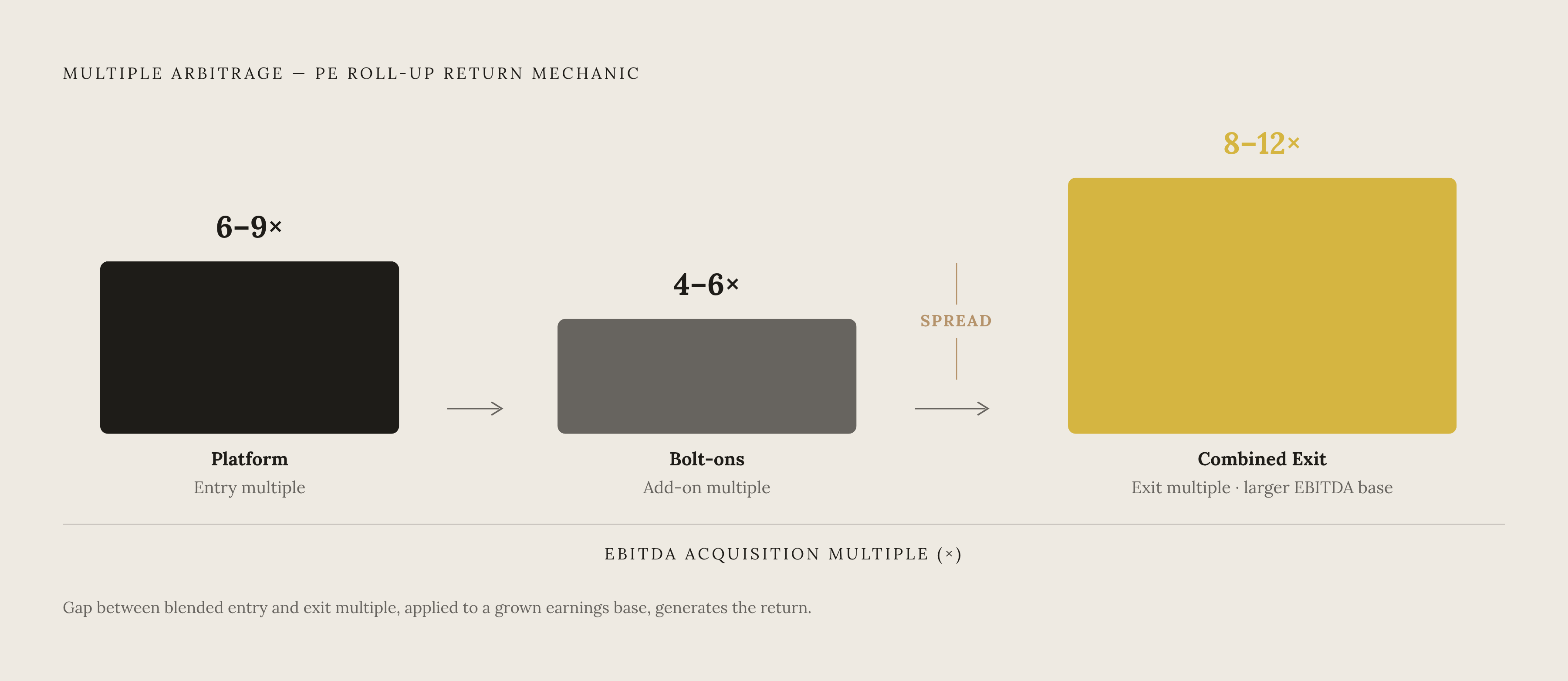
The math behind a roll-up is not complicated, which is part of why it's so popular. A PE firm buys a platform company for something like 6 to 9 times EBITDA, then goes shopping for smaller operators in the same space, picking them up at 4 to 6 times. Bolt those smaller companies onto the platform, hold for a few years, and sell the whole thing for 8 to 12 times EBITDA. The spread between what you paid and what you sold for, multiplied across a much bigger earnings base, is where most of the return comes from. Organic growth helps. It's not the engine.
The buyer at the end isn't writing a check for EBITDA. The buyer is paying extra because they believe they're buying a platform, a single entity that looks less risky, scales more easily, and appeals to more potential future buyers than a pile of separate businesses would. That belief is the entire product being sold at exit. It is the thing the premium is attached to, not a side effect of good financials.
Which means the whole thesis rests on perception, and perception gets built through language long before it gets built through spreadsheets. A buyer forms a view of "is this one company or fifteen" based on how the platform describes itself, how consistently its people talk about what it does, and how quickly a new piece bolted onto the platform starts sounding like the rest of it. Get that perception wrong, and the multiple compression that follows has nothing to do with how good the underlying businesses actually are.
Language fragmentation inside a bolt-on platform after several acquisitions
Picture a holding company that has bought fifteen regional businesses over three or four years. You can consolidate a balance sheet in an afternoon. You cannot consolidate fifteen origin stories that fast.
The operational symptoms appear fast, in plain view. Fifteen CMS platforms running fifteen different websites. Every marketing campaign gets built once, then rebuilt fifteen times to fit fifteen different identities, so the central marketing team the holding company hired to create scale ends up running something closer to a small ad agency juggling fifteen clients who all happen to be the same company.
Three different stories get told at once, and they don't agree with each other. Three audiences, three scripts, and nothing connecting them.
Brand architecture, in most of these platforms, isn't a decision anyone made. It's a record of deal history. The business is one company on a cap table and a loose confederation of regional outfits everywhere else, filing one set of consolidated financials while operating like fifteen roommates who split rent but keep separate refrigerators.
Fragmentation as a category risk, not just a branding problem
Every company gets compared to something when a buyer tries to value it. If the roll-up has a clear, specific story, it gets compared to the best version of that category. If it doesn't, the buyer's brain fills in the blank with whatever's nearest, and whatever's nearest is almost always a cheaper comparison than the one the sellers were hoping for.
Is the platform a national services brand? A technology-enabled operator? A category-defining platform business? If nobody can answer that in one sentence, the buyer answers it for you, usually by comparing the business to the nearest competitor they already understand, at that competitor's multiple, not the premium one.
Buyers in this market have gotten good at spotting a company that consolidated EBITDA versus a company that actually built something. They don't just run the financial model. They read the pitch materials, talk to customers across different units, and notice when the story one acquired business tells doesn't match the story another one tells. That scrutiny lands directly on the narrative, not just the numbers.
Consider a software roll-up that owns a leading CRM tool and a leading accounting tool, both genuinely strong products, both still running under their original, unrelated brand names with nothing tying them together. A loose federation of regional names that still needs to be stitched together gets a worse price, every time.
Most post-mortems blame failed roll-ups on systems that never got integrated or cultures that never quite merged. Both of those things are usually true. The acquired companies never built a shared answer to who they are, what they do, and why any of it matters, and that is the simpler explanation hiding behind the systems and culture excuses. That's a category risk sitting on the books disguised as an operations footnote. It is being tracked under the wrong line item.
How language debt compounds across the holding period
Technical debt is a useful comparison here because the mechanics match almost exactly. Language works the same way inside a roll-up. Each new acquisition that gets bolted on without being folded into a shared story adds another layer of debt, and the debt doesn't sit quietly. It costs money while everyone waits to deal with it.
Some of that cost is painfully direct. None of this is a one-time integration bill. It's a recurring drag on EBITDA that keeps bleeding for as long as the fragmentation stays unresolved, quarter after quarter, invoice after invoice.
Something like 30 to 40% of PE roll-ups come in under the returns investors originally expected, and the usual culprits cited are integration problems, a weaker multiple at exit than modeled, or operational dis-synergies that were supposed to be synergies. Almost none of those post-mortems name language fragmentation as the cause, even when the actual mechanism tracing through the failure runs straight through it.
A few blunt questions tell you how much debt has built up. How many different definitions of "the platform" would you get if you asked five executives across the business? How many separate sales decks exist, each telling a slightly different version of the same company? How many origin stories get told depending on who's doing the telling? And when a new acquisition comes in, how long does it actually take before that business sounds like it belongs to the rest of the platform. Those answers are the balance sheet nobody is keeping.
The Risk of AI Deployment Across a Fragmented Platform
It would be convenient if AI tools just cleaned this mess up automatically. That is not what happens. When a roll-up rolls AI tools out across a platform that already has fifteen conflicting stories running through it, the models don't pick the correct version and standardize on it. They learn from everything they're fed, contradictions included, and they produce more of all of it, faster and at a much bigger scale.
To be fair to the technology, the upside case is genuine. None of that is in question.
Those same models are trained, inside a fragmented platform, on years of pitch decks, customer emails, internal memos, and sales materials, each one carrying its own version of what the company actually is. The model doesn't sort through those versions and pick the right one. It blends them, and it reproduces that blend at whatever volume you point it at.
A roll-up that turns on AI-assisted sales enablement, customer messaging, or internal knowledge tools before it has actually resolved which story is the right one runs that same fragmentation through a megaphone, pushing more inconsistent messaging into more customer conversations than a team of humans typing by hand ever could.
The window for keeping this intentional is closing. Whatever language the organization is actually running on when it turns the AI on becomes the training signal going forward. Fix the story first, and the system compounds a clean signal. If the story stays broken, the system compounds noise, at scale, in front of customers and acquisition targets and eventually in front of exit buyers.
What Diligence Frameworks Miss on Narrative
PE diligence has gotten very good at certain things. There is no equivalent workstream for what might be called quality-of-language, no standard set of questions a diligence team runs to check whether the platform's story actually holds together across its pieces.
That gap costs money downstream, usually dressed up as something else. Leadership teams disagree about strategy because they're quietly working from different definitions of what the company is. All three get filed under culture problems or management problems. All three trace back to a language problem nobody was checking for.
Roll-ups have it worse than a single acquisition because the integration risk compounds across every deal, often signed in quick succession with the same small management team trying to absorb all of it at once. The narrative integration gets pushed to "later," and later has a way of never arriving.
Holding periods have stretched out well past the point where unresolved narrative fragmentation starts actively compressing EBITDA and narrowing the list of buyers willing to pay a premium at exit. Waiting isn't a neutral choice. Every quarter the story stays fragmented, the debt from the earlier section keeps accumulating.
The usual answer to all of this is "we'll clean up the brand before we sell." That answer doesn't hold up. Buyers doing diligence will read the sales materials, talk to customers, and see the same fragmentation a roll-up has been living with internally for years. A platform that looks like a federation in its own pitch deck is handing the buyer evidence of exactly the integration risk it's hoping they won't notice.
Narrative as a governance and infrastructure problem across a roll-up platform
Fixing this isn't a rebranding project you hire an agency to wrap up in a quarter. It means building a shared language system that holds across every entity in the platform, the same way a shared financial reporting system holds across every entity's books.
The first real decision is architectural, and it has two honest paths. One is a Masterbrand approach: retire the legacy names entirely and operate under a single unified identity. The other is an Endorsed approach, something like "Backed by [Holding Company]," which keeps each local brand's name and reputation intact while transferring trust from the parent over time.
Which path fits depends on what's actually driving the business. Masterbrand tends to make sense in commoditized, transactional categories, logistics, IT managed services, commercial maintenance, where a buyer cares more about national reach than about any one local relationship, and where cross-selling across the combined customer base is the whole point of consolidating. Endorsed branding tends to make more sense where the local relationship is the thing customers are actually paying for, healthcare, veterinary practices, home services, specialist consulting, where stripping out the local name would strip out the exact trust the margin depends on.
Either way, this is a strategic call, not a design preference. It needs to get made at the first bolt-on, or before it, not retrofitted after a dozen acquisitions have already locked in a dozen incompatible identities that now all need to be unwound at once.
Real narrative governance goes further than a style guide sitting in a shared drive somewhere. It means a shared, written definition of what the platform actually is. One origin story flexible enough to absorb the next acquisition without having to be rewritten from scratch. A system for managing vocabulary across the business so each new company onboarded sounds like it belongs.
Track the onboarding timeline for each new acquisition into that shared story the same way systems integration timelines get tracked, as a real KPI with a number attached, not a vague aspiration. Language shapes which version of the business gets to exist.
Narrative intelligence as a diligence and value-creation capability for PE investors
Quality-of-earnings has a standard diligence workstream, and quality-of-language doesn't, even though the second one sits directly beneath the multiple a buyer is willing to pay. Narrative intelligence is what closes that gap, owned with the same seriousness as a financial or legal review.
Before close, that means asking the questions nobody standardizes yet. How many competing definitions of the platform exist across its leadership team. How long it actually takes a new acquisition to sound like it belongs. Whether the investor story, the customer story, and the acquisition story are saying the same thing or three different things to three different audiences.
After close, it means treating the fix as infrastructure investors build once and maintain, not a project they pay for once and hope sticks. A platform that gets its language governed early carries less debt into its AI rollout, less debt into its tenth bolt-on, and less debt into the room with the exit buyer who's deciding whether they're looking at one company or fifteen wearing the same ticker symbol. That decision was never really about the brand; it was about whether the premium the whole thesis depends on actually appears at the end.