IPO Pricing and Category Ownership Correlation in Cloud Software
Category ownership now matters more than growth rate in cloud software IPO pricing.

The 2025 and 2026 cloud software IPO market looks like a recovery from a distance. Up close, it's a sorting machine. It separates companies that own a category from companies that merely compete inside one, and the gap between those two groups is what this whole piece is about.
The 2021 boom ended in a drought that lasted years. The window that's reopened now is narrower than the one that closed, more selective about who gets through, and priced by different rules. Capital is moving again, but it's moving toward AI infrastructure, fintech, and biotech. Pure-play horizontal SaaS is down substantially from a year ago. Vertical SaaS, by contrast, is holding roughly flat, a sign that investors aren't rejecting software, but being picky about which software.
As of June 2026, the public-market median EV/Revenue for cloud software is in the low single digits (per the SaaS Capital Index, equal-weighted). The BVP Nasdaq Emerging Cloud Index's average, not its median, ran meaningfully higher in late June 2026. Top-quartile public SaaS companies still clear multiples well above that median. The bottom quartile is around 2x. Same asset class, same macro backdrop, same calendar quarter, and still a wide spread between the top and bottom of the pack.
That spread is the real story, more than the median itself. If growth rate were the only thing driving price, you'd expect the fastest-growing companies to cluster near the top and the slower ones near the bottom, with a fairly clean line connecting them. That's not what the data shows. Something else is sorting these companies into bands, and the rest of this piece is spent figuring out what that something is.
Why growth rate alone no longer predicts where a company prices within that dispersion
Growth rate used to be the whole conversation. A company growing substantially faster priced well above a company growing much more slowly, more or less regardless of anything else. That relationship has weakened. Investors are pricing narrative legibility as its own line item, not as a nice-to-have bolted onto a pitch deck.
Firms that specialize in narrative strategy and messaging analysis, like Storiedinc, have spent decades building category-ownership frameworks for scaling organizations. What's changed is that underwriters are now treating that architecture as a hard constraint on institutional allocation, not a soft asset that helps at the margins.
The IPO lane hasn't simply closed to slower-growing companies. It's closed to companies whose category claim is fuzzy, no matter how fast they're growing. Coherence in the story has become a gate you have to pass through before the market will price the rest.
Part of this comes down to how an IPO actually works. It's a negotiation between management, underwriters, and institutional investors, and the thing being negotiated isn't only the price, but whether the category frame is credible enough to hang a price on. A company that can't name what it owns gives underwriters nothing to point to when they're trying to convince a pension fund or a mutual fund to take an allocation. Underwriters need an answer when a buyer asks what a company actually is. "A faster version of something that already exists" is a much harder sell than "the thing that didn't have a name until we built it."
LPL Research makes a related point: the price at IPO and the price at first public trade are not the same event, and the distance between them matters. A company can be genuinely excellent and still turn into a disappointing IPO investment if the first public price has already baked in years of optimistic growth. That tends to happen when investors can't agree on what category they're even pricing. Confusion about the category gets expressed as price volatility, because different investors are quietly pricing different companies under the same ticker.
The spread between top-quartile and bottom-quartile multiples doesn't trace back to the financials alone. Revenue, margin, and growth explain part of it. The rest maps onto something closer to belief: do investors think this company owns its category, or just competes in it?
What Figma's first-day pricing reveals about the category-ownership premium
Figma's first day of trading is the cleanest data point available on what investors will pay, above the offer price, for a company that convinces them it defined a brand-new category rather than joined an existing one.
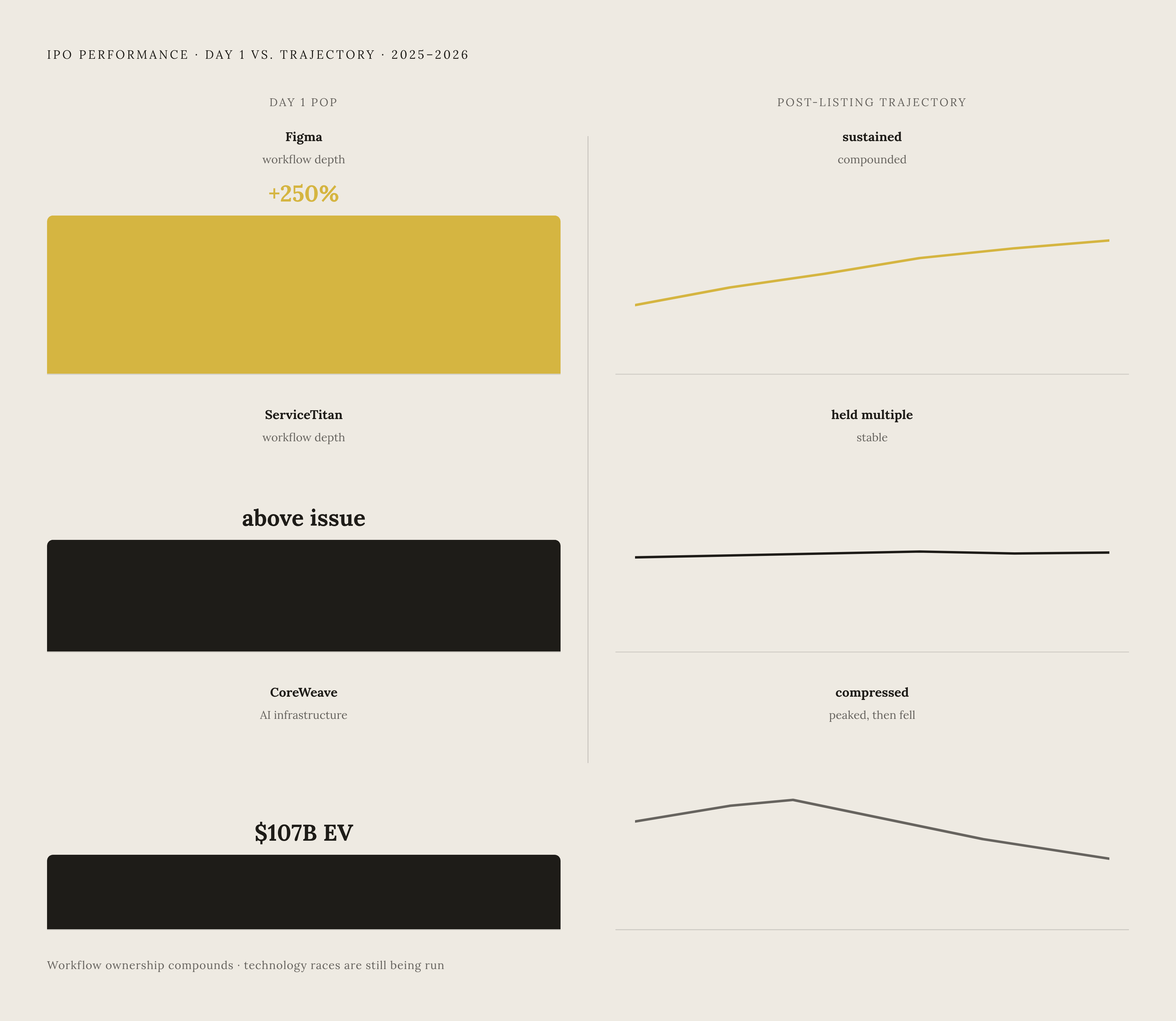
Figma priced below where it opened, opened at more than double its issue price, and closed its first day up roughly 250 percent. That's the largest first-day pop for a billion-dollar IPO on record. The gap between the IPO price and the closing valuation wasn't a pricing error or a fluke of thin trading. It was public-market investors showing, in real dollars, that they'd found a category claim they couldn't buy at any earlier price, and they were willing to pay up once the door opened.
Figma's S-1 didn't pitch the company as a design tool going up against Adobe. It framed the entire software-creation lifecycle as Figma's territory. The filing states that "design spans far beyond a single step or role" and that "design is also how something works. That's a redraw of the map before a single investor sat down to do valuation math. No prior competitor had claimed that particular space, so there was no existing reference class to slot Figma into. Investors had to price it against a category that, in effect, didn't have a name until Figma gave it one.
That kind of category architecture, where the language comes before the product positioning and ends up anchoring how investors price the whole company, is the output of deliberate strategic narrative work: engineering how a market names what a company owns before the market has decided on its own. It's exactly the intersection where messaging strategy touches IPO outcomes directly instead of staying in the marketing department.
The claim wasn't just a pitch for the roadshow, either. Figma's Net Dollar Retention Rate ran in the triple digits, existing customers expanding their usage and spend over time, which is the operational evidence underneath the language. Customers were, in effect, voting with their renewal checks that the category Figma described was the one they were actually living in.
ServiceTitan's vertical SaaS category claim versus horizontal AI hype
The category-ownership premium holds up when it's built on workflow depth that's hard to copy. It gets shakier when it rests mainly on infrastructure positioning or AI hype, where the premium appears at listing but doesn't always survive the following months.
ServiceTitan went public in December 2024 at a valuation in the high single-digit billions and opened well above its issue price. The pop came from demonstrated execution in a clearly defined vertical market. ServiceTitan's category claim is narrow on purpose: it calls itself the operating system for the trades, meaning HVAC, plumbing, and electrical contractors. That's a market horizontal software can't easily walk into, and it's one that AI-native challengers can't out-maneuver at the workflow level without years of domain-specific training data most of them don't have.
Compare that with CoreWeave, which listed in early 2025 at an enterprise value of $107.4 billion on the strength of a GPU cloud-native AI infrastructure story. The category claim is what drove that initial number. But the stock peaked and then compressed substantially in the months that followed. It's a demonstration that even a well-built category narrative gets repriced hard when the underlying economics can't keep pace with the story that launched it.
Line the two up: workflow depth, the kind Figma and ServiceTitan both claim, tends to hold its multiple over time. Infrastructure positioning and frontier AI claims tend to produce a bigger pop on day one and a lot more turbulence after. Investors aren't rejecting category narratives. They've gotten better at telling a narrative built around owning a workflow apart from one built around leading a technology race. Workflow ownership compounds. A technology race is, by definition, still being run.
Entrata as the live test of whether profitable growth without a category claim is enough to price at a premium
Entrata is the company that tests whether good numbers alone are enough, because it has the numbers and still faces real questions about its category.
Its fundamentals are genuinely rare for a company heading toward an IPO. Entrata's S-1 reports GAAP net income, a meaningful year-over-year revenue increase, and a net retention rate of 117% as of the end of both 2024 and 2025. That combination, meaningful growth alongside actual GAAP operating profitability, is being described as potentially the largest software company ever to go public with both traits intact at the same time.
The open question sits with category position, not financials. Entrata competes against RealPage, owned by Thoma Bravo, and Yardi in property management software, and both of those are larger incumbents. Entrata hasn't yet staked out a category frame that makes it the obvious defining platform in its space, as opposed to the faster-growing challenger chasing two bigger players. That's a real distinction, and the market hasn't settled it yet.
Public markets are going to answer a direct question with Entrata's pricing: does "the better-run incumbent replacement" get valued like category ownership, or does it get valued like competition? Whatever the answer turns out to be, it will say something larger about where this market stands. Either quality execution and strong numbers are enough to earn premium pricing on their own merits again, or category ownership remains a structural requirement no amount of GAAP profit can substitute for.
Anthropic's IPO narrative and the limits of frontier category claims
At the frontier of AI, the category-ownership premium turns into something bigger: a category-existence premium. Anthropic's narrative burden isn't to describe a market that already exists and explain where it fits inside it. The burden is to convince investors that the market it's describing will actually show up, and at a scale that justifies the valuation being asked.
The bull case here leans on stickiness in the enterprise and API business, the parts of the company less visible to anyone outside a developer console. That means the public story has to convince investors to value enterprise coherence, which is less visible in a consumer app store or a splashy ad campaign, over the kind of consumer brand recognition that usually carries a large, retail-visible IPO. That's an unusual sell. Most mega-IPOs lean on a brand name the public already recognizes. Anthropic's pitch runs the other direction, asking generalist investors to trust a business relationship they mostly can't see happening.
None of this is a verdict on whether the company's eventual valuation is justified. The mechanics matter here more than a judgment call on the price. Frontier AI pricing asks investors to underwrite the existence of a market at a scale that hasn't been proven yet, which is a different and heavier lift than underwriting a company's share of a market that's already known to exist.
Stripe's "financial OS" framing as a valuation multiplier
Stripe never needed an IPO to show that category language changes price. It made the case privately, years before any roadshow, by calling itself the "financial OS" instead of a payments processor.
That's not a rebrand for its own sake. It shifts Stripe into the position of a platform layer rather than a vendor, and platform layers get priced on infrastructure-level multiples, a different ceiling entirely from the one payments companies usually bump into. Same underlying business, different reference class, different number attached to it.
The "financial OS" framing has been pointed to as a key growth narrative for the company's anticipated public debut, which tells you the category language was built with the eventual valuation conversation already in mind, not written after the fact to explain a number that had already landed. Stripe didn't wait for investor pressure to define what it was. It defined itself first and let the market catch up.
That's the same move Figma made in its S-1 and the same move ServiceTitan made by calling itself the operating system for the trades. In every one of these cases, the company put category language in place long before it needed anyone to price it. The language didn't follow the valuation. It came first, and the valuation followed the shape the language had already drawn.
What narrative legibility requires structurally
Category ownership is the output of language architecture put in place, kept consistent, and tested across every surface, investor-facing, customer-facing, internal, long before an S-1 ever gets filed, well before roadshow season.
The roadshow squeezes the entire investor relationship into a few short weeks. Any gap between what the company says about itself, the category it claims, how its product is positioned, and what the financials actually show, gets noticed almost immediately. Investors price that gap as ambiguity, and ambiguity gets a discount. That means the language work has to be finished well before the roadshow starts. It can't be assembled during it.
Net revenue retention turns out to be a useful read on this, almost a secondary measurement of narrative coherence. Customers expand their usage when they clearly understand the value language around a product and when every team inside the company is saying the same thing about what that product does. A strong retention number is a sign that an organization is running on one shared, canonical account of itself, instead of a patchwork of competing descriptions written department by department.
AI is turning up the volume on all of this. Buyers now have more tools than ever to research a company, compare its claims against its competitors, and spot inconsistencies in minutes rather than weeks. A category claim that's fuzzy, or that shifts depending on which page of the website someone lands on, gets caught faster than it used to. The companies pricing at a premium in this market, Figma, ServiceTitan, Stripe before it ever filed anything, all did the language work early, kept it consistent, and let the operational numbers back up what the words were already saying.