Narrative Diligence Frameworks for Early-Stage Investors
VCs skip narrative coherence checks, missing a key predictor of scaling failure.

Standard VC due diligence runs on seven workstreams, and none of them checks whether a company's story actually holds together. The 2026 checklist most funds work from covers financial, legal, commercial, operational, HR, technology and IP, and risk management, each with its own scored sub-items, amounting to a lot of scoring. None of it touches narrative coherence.
The pattern holds at the fund level too. The Neotas 2026 guide to investment due diligence points to the "4 P's", People, Performance, Philosophy, Process, as the standard framework for PE and hedge fund managers assessing a target. Four P's, zero dimensions for whether the company's story holds up the same way across the founding team, the investor deck, and the market it's selling into. You'd think "Philosophy" might cover it. It doesn't, at least not as a scored line item.
The gap reflects a structural choice: the resourcing goes to whichever workstream is easiest to check off, not the one causing the most damage after a deal closes. It's architecture. The financial workstream gets the lion's share of resourcing because it's the easiest thing to build a checklist around: revenue, burn, runway, cap table math. All countable. But Bain's 2025 research, cited in Neotas's own guide, found that operational and commercial risks account for most of the disappointments that show up after a deal closes, with people problems running a close second. The workstream getting the most attention isn't the one causing the most damage.
How a fast-moving deal environment suppresses narrative evaluation
None of this is because investors got lazy. Global venture funding jumped sharply in 2025, the third-largest year on record, even as the total number of completed deals fell. Do the math on that combination: more capital, fewer deals, which means each check that does get written is bigger and gets less scrutiny time per dollar deployed.
Layer AI on top of that. AI-focused companies pulled in well over half of all 2025 venture funding, and a lot of them are building in categories that don't have settled vocabulary yet. Try running a standard "does the pitch match the product" check on a company defining a category that didn't exist a short time ago. The check still runs. It's just guessing.
The funnel itself adds pressure from the other direction. Investment memo practice at top firms shows the average firm screening a large pool of companies to land on a small handful of actual investments each year, something like a 2% hit rate. By the time a memo gets written, that company has already survived multiple rounds of screening, and surviving screening creates its own bias: the team writing the memo is inclined to confirm the story that made it through, not stress-test it.
So what happens under that kind of time pressure? Investors reach for the signals that are fastest to verify: unit economics, retention cohorts, whether the GTM engine looks repeatable. Diligence guides describe pre-seed and seed-stage diligence as "typically faster and more qualitative," and in practice, that softness is where narrative coherence lives, or rather, where it doesn't get evaluated at all. It becomes a gut call. Somebody on the deal team either likes how the founder talks about the business, or they don't, and that feeling stands in for a method that doesn't exist yet.
What narrative fragmentation costs a scaling company
Narrative fragmentation runs up a real bill, and it spreads that bill across departments so nobody sees the total. Unclear or inconsistent language inside a company does not appear as one line item on a budget. It is visible in longer onboarding cycles in training, more escalations in customer support, extra supervision needed in operations, and messier performance reviews in HR. Every one of those costs is invisible to a standard financial review, because financial review looks at what got spent, not why three different departments are quietly re-explaining what the company does to new hires every month.
The mechanism behind this has a name in the academic literature: researchers describe it as a shift in how innovation narratives evolve as a company scales. Research published in the Journal of Product Innovation Management (2025) tracks how innovation narratives shift as a company scales: they move from a shared founding story into what the researchers call retrogressive storytelling, where incumbent employees and newcomers each lean on their own version of the company's past. Eventually that produces "disintegrated storytelling," where competing versions of the story actively get in the way of coordinating any innovation work. Translation: the story that got everyone excited on day one doesn't survive contact with headcount growth unless somebody actively manages it.
That's the trap at the center of scaling. A loose, low-fidelity founding story is genuinely useful early on, because it lets new employees picture themselves helping write it. Growth forces that story to firm up into something more official, and the people who joined the looser version can find themselves excluded from the one that replaced it.
Most scaling companies see cultural alignment measurably decline within the first three years of significant growth, and narrative incoherence sits on both sides of that: it's a leading indicator the decline is coming, and it's part of what's causing it. An investor with no way to check narrative health before signing the term sheet has no way to see that decline approaching either. The financial model looks fine right up until the quarter it doesn't.
How AI scales whatever narrative a company runs on
AI-powered search and LLM-driven discovery took narrative incoherence out of the category of internal friction and put it into the category of market positioning, automatically and at scale. A confused internal story used to stay mostly internal. It doesn't anymore.
Large language models figure out what a brand stands for by reading its consistent (or inconsistent) narrative across its entire online footprint, and they use that read to shape what they recommend to buyers. A fragmented company story stops being an internal headache the founders can fix over a few offsites. It gets encoded into every AI system a future customer or investor consults before they ever talk to a salesperson.
Scale that against the size of the systems doing the encoding. The global LLM market was already worth $7.77 billion in 2025 and is projected to keep expanding through the year ahead. Those systems are growing faster than most early-stage companies' ability to actually govern their own language.
That raises a specific question for anyone doing diligence on a founding team right now: if the founders can't tell a consistent story about the business today, what version of that story gets picked up and repeated by an LLM to buyers over the next two years, and who's supposed to go back and correct it? There's no clean mechanism for issuing a correction to a model's training data on a rolling basis. An investor who does not evaluate narrative coherence before investing may find that by Series A, the company's market position has already been misdefined, not by competitors, but by the company's own inconsistent language, now reflected back at scale through AI-generated search results and discovery experiences. Nobody stole the category. The company just let an algorithm write its own positioning for it, by accident.
Narrative coherence predicts stalls that financial diligence cannot see
Narrative fragmentation at the early stage produces three specific kinds of stall, in fundraising, in hiring, and in go-to-market, and all three appear in the financial statements only once the damage is already done.
Take fundraising first. A company sitting below median ARR benchmarks for its stage is leaning heavily on its narrative to explain why growth is about to inflect, and that story carries outsized weight in the decision. Investors currently have no diagnostic tool for telling whether that growth story is structurally sound or just vague optimism dressed up in a deck. So the check gets written on a gut feeling, or it doesn't get written, and either outcome is a coin flip masquerading as a decision.
Hiring friction runs on a similar mechanism, just aimed inward instead of at investors. A founding story that gets told differently by different team members signals to every candidate sitting in an interview loop that the company hasn't figured out what it is yet. Employees who join around a fuzzy version of the story form their own private interpretation of it, and that mismatch causes execution problems later that nobody can trace back to their actual source.
Then there's go-to-market, which is where this all becomes a pipeline problem rather than a philosophy problem. A 2026 compilation of launch data found that companies with a documented go-to-market strategy have a dramatically better shot at a successful launch than those without one. Narrative clarity is the thing that makes a GTM strategy documentable in the first place. Without settled language for the problem, the buyer, and the category, a GTM motion has no spine, and every sales rep ends up re-teaching category basics from scratch on every single call. Multiply that across a sales team and you're paying, in wasted call time, for a narrative problem that never got flagged as one.
Category creation makes the stakes worse. Building a brand-new category requires repeated buyer exposure before an unfamiliar idea starts to feel credible instead of strange. Change the story every quarter because the metrics look slow, and the exposure count resets to zero. That's not a marketing inconvenience. For a fund, it's the difference between a portfolio company that compounds category ownership over time and one that keeps restarting the same introduction, burning runway on repeat.
The structure of a narrative diligence framework
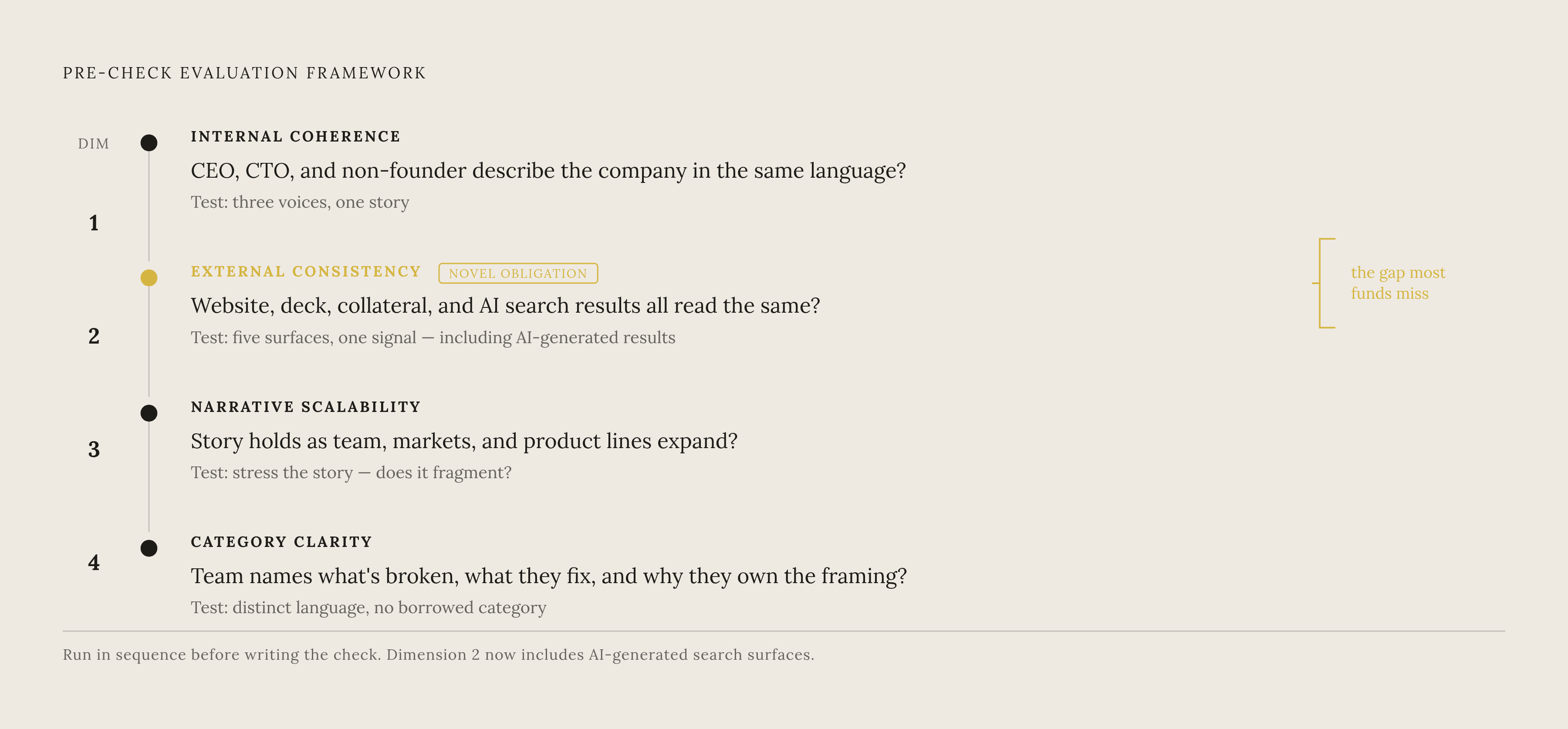
A narrative diligence framework takes "does the story hold up?" out of the realm of gut feeling and turns it into something scored and repeatable, across four dimensions, before any check gets written.
Dimension one is internal coherence. Can each member of the founding team describe what the company does, who it serves, and why it wins, using roughly the same language, without being fed the answer? Test this with short, separate conversations with the CEO, the CTO, and at least one team member who isn't a founder, and score how much their answers diverge, not just how polished each one sounds on its own. A CEO with a sharp pitch and a CTO with a completely different mental model of the product is a coherence problem hiding behind a good deck.
Dimension two is external consistency. Does the company read the same way across its website, its sales collateral, its pitch deck, and the language its own customers and partners use when they describe it back? Any mismatch there means the canonical version of the story never actually made it out of the founder's head into the rest of the organization. In an AI-mediated buying environment, this dimension has to stretch further than it used to: a pre-investment audit now needs a prompt-based check of how the company shows up in AI-generated search results, because that's what a buyer runs into well before any human sales conversation starts.
Dimension 3 is narrative scalability, meaning whether the story is structured in a way that can absorb new team members, new markets, and new product lines without fragmenting. A founding story built entirely around one founder's personality or a single early use case is a dependency risk sitting quietly on the balance sheet. The same Journal of Product Innovation Management research described earlier identifies this exact failure mode: growth-driven instability causes the founding story to fall apart, with different groups inside the company developing their own competing versions of it. A pre-investment framework needs to check whether the story has the architecture to survive that pressure, beyond whether it sounds good in its current, unstressed form.
Dimension four is category clarity, and it applies specifically to companies creating or claiming a new category. Can the team name what's broken in the category, what the company's solution fixes, and why this particular company owns that framing, in language that's actually distinct from whatever descriptors already exist in the market? Vague category language here is an early signal of go-to-market stalls and competitive erosion further down the line, the exact kind of risk the GTM section already laid out.
Score each of the four dimensions on a simple rubric. The goal is producing a signal that a deal team can compare across companies in the same portfolio and track over time inside a single company, the same way they already track burn rate or logo retention, rather than manufacturing false precision with decimal points on something inherently qualitative.
How narrative diligence works as a post-investment value-creation tool
None of this stops mattering once the wire transfer clears. A narrative diligence framework becomes the baseline a fund uses to audit, intervene on, and actively manage a company's language through every fundraising round that follows.
The pre-investment audit itself produces something concrete: a documented record of the canonical language the company was actually running on at the moment the check got written. That baseline gives a fund something to measure drift against as the company's market position evolves after investing. Without it, nobody can tell whether a company's story evolved on purpose or just wandered.
Portfolio companies that get a narrative audit built into onboarding, one that flags language debt, retires terminology nobody uses anymore, and lines the founding story up with where the company actually sits in the market today, tend to compress the gap between funding rounds. Their pitch for the next round is already coherent before the roadshow starts, instead of getting patched together in the final weeks before partner meetings.
For a fund running this across an entire portfolio, narrative diligence turns into a genuine platform capability: the ability to spot which companies are stalling because of a language problem rather than a product problem, and to step in with the same rigor a fund already applies to a financial or operational issue. Right now, most funds have that rigor built for spreadsheets and none of it built for language. A company that can't tell its own story straight carries a risk sitting in plain sight, waiting for someone to build the instrument that finally measures it.