The Role of Open Source Communities in Category Displacement
When vendors restrict open source licenses, community forks seize the category's language and win.
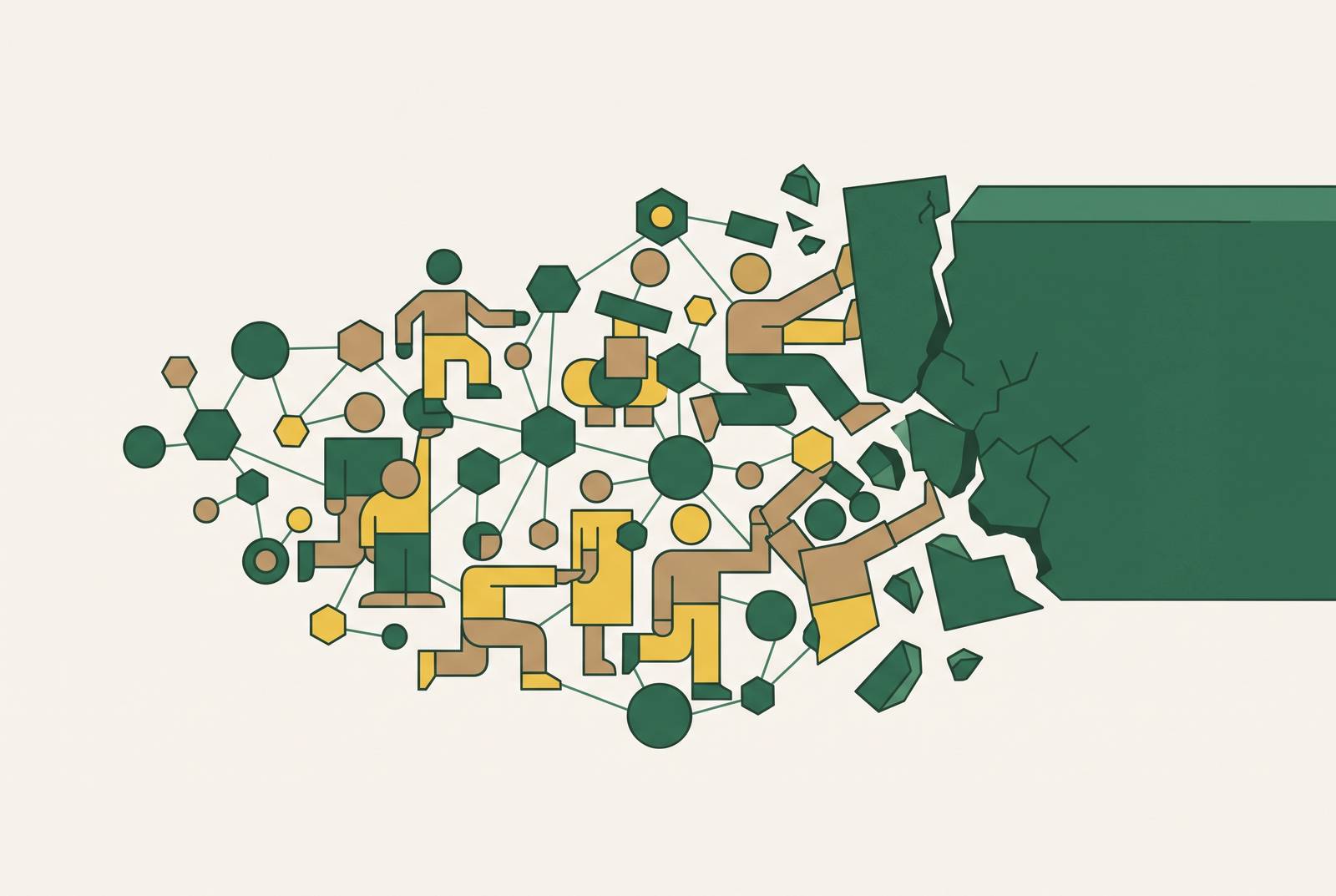
Every time a major open source vendor rewrites its license, the same sequence plays out. First, the vendor restricts terms to stop cloud providers from reselling its software without paying for the privilege. Then the community forks the last open version, hands it to a neutral foundation, and keeps building. Within a couple of years, the fork is setting the terms everyone else gets measured against.
Elasticsearch is the clearest case. In 2021, Elastic moved its license from Apache 2.0 to a combination of SSPL and the Elastic License 2.0. AWS responded by forking the last Apache 2.0 release, version 7.10.2, into a new project called OpenSearch. By September 2024, Elastic added AGPL as a third licensing option alongside SSPL and ELv2, a partial walk-back. OpenSearch, meanwhile, now sits under the Linux Foundation with more than 3,300 contributors.
Terraform followed a near-identical script. A vendor switched Terraform from MPL 2.0 to a source-available license in August 2023. The community responded with OpenTofu, launched under the Linux Foundation. IBM completed its acquisition of HashiCorp in February 2025, and the BSL terms stayed exactly as they were. OpenTofu has since passed millions of downloads, and Fidelity Investments has publicly described migrating its infrastructure from Terraform to OpenTofu.
Redis tells a related story along the same lines, with Valkey emerging as the community fork after Redis restricted its own license.
Set all three side by side: the architecture repeats with almost suspicious consistency. Each fork launched with a cloud provider or major backer behind it. Each landed inside the Linux Foundation. Each picked a license the open source community recognizes without argument: Apache 2.0 for OpenSearch, MPL 2.0 for OpenTofu, BSD 3-Clause for Valkey, and the pattern is one playbook, run three times, with the same result each time.
Why a license change is a language event
Reading these disputes purely as contract law misses what actually happened. A license change doesn't just adjust who can resell a product. It sets whether the vendor still gets to call itself "open source," and in enterprise software, that phrase carries more weight than almost any other in the category.
Elastic's own leadership admitted as much. Even though using Elasticsearch remained free under the company's proprietary terms, the license lacked something buyers and contributors cared about. A company co-founder said the licenses "just didn't have the stamp of 'open source.' That missing stamp cost the company standing in its own community, and reclaiming the term "open source" became a stated reason for adding AGPL back in.
AWS wasn't shy about naming the stakes either. AWS argued that Elastic was "trying to claim the benefits of open source, while chipping away at the very definition of open source itself," an argument about who gets to define a word, and whether Elastic still qualified to use it.
Words like "open," "community-governed," "neutral," and "foundation-backed" are the vocabulary buyers, engineers, and analysts reach for when they're trying to figure out what a piece of software is and whether they can trust it. Whoever controls those words controls how the whole category gets framed, long before anyone opens a pricing page.
How the fork reconstitutes the category
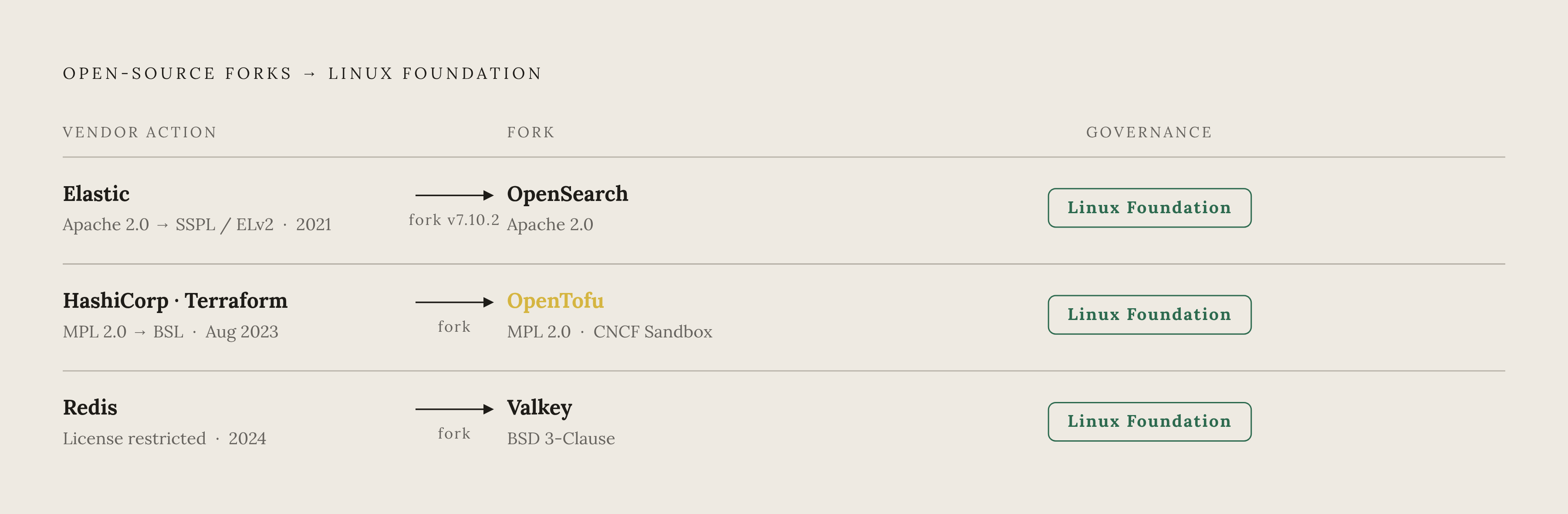
A fork doesn't just copy source code into a new repository. It resets where the category's center of gravity sits, and the original vendor starts orbiting a project it no longer controls.
Foundation governance does most of that resetting. The Linux Foundation and the CNCF function as a kind of credentialing body for open source infrastructure. A project under one of those umbrellas signals legitimacy that no single company, however large, can manufacture on its own. OpenTofu's acceptance into the CNCF as a Sandbox project made it a category artifact. Valkey and OpenSearch, both housed at the Linux Foundation, send the identical signal: this piece of infrastructure belongs to the community, not to whoever wrote the first commit.
License choice reinforces the same message. Apache 2.0 is the license the open source definition endorses without any asterisks attached, so choosing it is itself a statement. It tells the market: this fork is the legitimate heir to the category's vocabulary, not a derivative sitting outside it.
Cloud-provider backing closes the loop. AWS backed OpenSearch at launch. Valkey launched with AWS alongside Google Cloud, Oracle, Ericsson, and Snap. That kind of backing is an endorsement that tells the rest of the market where the operational center of the category has actually moved.
Put those three elements together, foundation governance, a permissive license, and cloud backing, and the result is a category reconstitution. Elastic adding AGPL back in is the clearest proof of the reversal: a vendor chasing a vocabulary standard the fork established first. When you're adjusting your own terms to match the fork's credibility, the fork has already become the category's reference point.
What vendors lose when they lose the language
Category displacement occurs in language before it appears in a revenue report. Once the community owns the vocabulary, the original vendor is competing inside a definition set by someone else, and every conversation from there forward starts on defense.
Losing the "open source" label costs a vendor its simplest, most powerful sales line: the ability to say, without any footnotes, that the project belongs to the community. Once that line is gone, every sales call, every analyst briefing, and every developer evaluation needs an extra paragraph of explanation that the fork simply doesn't need.
The fork also becomes the default yardstick. Buyers evaluating Terraform now measure it against OpenTofu's Apache 2.0 terms. Buyers evaluating Redis measure it against Valkey's Linux Foundation governance. The fork sets the standard, and the original vendor has to explain why it diverges from it.
Enterprise behavior confirms the shift. Fidelity's public migration from Terraform to OpenTofu is a signal that travels well beyond Fidelity's own infrastructure team. When a company with that kind of visibility moves, it ratifies the fork's claim on the category for every other buyer watching from the sidelines.
Reversals don't undo the damage. Elastic adding AGPL and Redis adding AGPLv3 recover the label, but neither recovers the position. The forks keep their contributor bases, their foundation governance, and their claim to being the community-first option. The original vendor goes from owning the category uncontested to being one option among several inside a category someone else now defines.
The structural conditions that make community language capture possible
This pattern isn't a lucky accident that happened to strike three companies in a row. Four conditions have to line up for a fork to pull off a full category capture, and those four conditions are far more common than most vendors would like to believe.
The project has to function as critical infrastructure, something organizations rely on operationally rather than something they merely admire philosophically. Terraform, Redis, and Elasticsearch all qualify because ripping them out is expensive and disruptive, which gives the community a strong, material reason to keep a neutral alternative alive.
A credible institutional home has to exist to receive the fork. The Linux Foundation and the CNCF have become the standard governance infrastructure for exactly this purpose, supplying the legal and organizational scaffolding that turns a fork from a one-off protest into a durable platform.
A cloud provider or major backer with real distribution reach has to be willing to fund the fork at launch. Without that kind of backer, forks stall out for lack of resources. With one, they can reach adoption thresholds fast enough to establish legitimacy before the original vendor has time to mount a response.
The original vendor has to have been open long enough for a real ecosystem, contributors, integrations, tooling, documentation, to form around the project in the first place. The richer that ecosystem was before the license change, the more a fork can inherit wholesale, and the faster it reaches technical and narrative parity with the original.
None of these four conditions is unusual on its own. Together, they describe most mature, category-defining open source infrastructure projects operating today, which makes this a mechanism with known prerequisites, and plenty of projects currently meet all four without anyone at the company noticing yet.
Why AI deployments make category vocabulary more consequential
AI systems trained on an ecosystem's documentation, forums, and discussion will reproduce whatever vocabulary already dominates that ecosystem. That means the fork that wins the category's language doesn't just win over the current generation of human buyers. It shapes how AI tools describe, recommend, and reason about the category for years afterward.
AI doesn't resolve a fragmented or contested category narrative. It amplifies whichever narrative is already strongest in its training material. A system trained mostly on content treating the fork as the standard will repeat and reinforce that framing across every summary, recommendation, and generated comparison it produces, at a scale no single human analyst could match.
Open source infrastructure communities also move fast. The pace of contribution inside fork ecosystems like OpenTofu and Valkey means the language, documentation, and conceptual framing of the category shift faster than any vendor on a quarterly or annual release cycle can keep up with. The open source AI landscape follows this same fork logic: the gap between proprietary frontier models and open alternatives on general knowledge benchmarks has narrowed considerably, turning the AI infrastructure category battle into a contest over narrative and ecosystem alongside raw capability.
For enterprise buyers, this appears earliest in the tools that now sit in front of every purchase decision. Procurement systems, vendor comparison platforms, and AI-assisted analyst summaries will increasingly reflect whatever vocabulary the dominant community project has already established. A vendor that lost the category's language is at a disadvantage in the AI-mediated research that happens before any human sales call ever gets scheduled.
What companies controlling category language should take from this
The lesson here is that category language works like infrastructure, not like messaging, and companies that treat it as a communications asset rather than a structural one are quietly building the exact vulnerability that made all three forks possible.
Category language needs active governance, not just repeated use. OpenSearch, OpenTofu, and Valkey didn't win because their code was better at launch. They won because they built governance structures, neutral foundations, permissive licenses, genuine community ownership, that made their claim to the category's vocabulary more durable than the original vendor's claim ever was.
The parallel to technical debt maps almost exactly: technical debt piles up quietly until a system buckles under real load. Language debt builds the same way: a company's category vocabulary drifts, fragments, or gets contested over time, and the debt comes due the moment a competitor or a community offers a cleaner, more credible claim to the same words.
This risk isn't confined to open source. Any platform company or emerging-technology vendor whose technology is moving faster than the market's vocabulary for describing it faces the same exposure. A company that doesn't actively architect and govern the language of the problem it solves will eventually find the market defining that category on its own terms, with the company competing inside a definition it never had a hand in writing.
Investors evaluating platform and infrastructure companies have a new diligence question worth adding to the list: who currently owns the vocabulary of this category, how durable is that ownership really, and what would it take for a community or a competitor to fork the language the same way OpenTofu forked Terraform's. A technology moat doesn't mean much if the words describing the category have already drifted out of the company's control.
Narrative infrastructure, the language, governance, and canonical documents that define what a category is, who it serves, and why it matters, is a structural capability, one that has to be built deliberately, maintained continuously, and defended the same way a company defends any other strategic asset. The practical starting point looks a lot like the technical audits open source foundations run before they even consider a fork: list the words that currently define the category, identify who actually owns each one in the market's mind, and mark the specific places where a competitor or a community could make a more credible claim to those words than the company currently holds. Those are the exact points where the next OpenTofu gets born.